Hunger
by Kelli Russell Agodon
If we never have enough love, we have more than most.
We have lost dogs in our neighborhood and wild coyotes,
and sometimes we can’t tell them apart. Sometimes
we don’t want to. Once I brought home a coyote and told
my lover we had a new pet. Until it ate our chickens.
Until it ate our chickens, our ducks, and our cat. Sometimes
we make mistakes and call them coincidences. We hold open
the door then wonder how the stranger ended up in our home.
There is a woman on our block who thinks she is feeding bunnies,
but they are large rats without tails. Remember the farmer’s wife?
Remember the carving knife? We are all trying to change
what we fear into something beautiful. But even rats need to eat.
Even rats and coyotes and the bones on the trail could be the bones
on our plates. I ordered Cornish hen. I ordered duck. Sometimes
love hurts. Sometimes the lost dog doesn’t want to be found.
Previously published on the Academy of American Poets website:
Poets.org Poem-a-Day 2017.
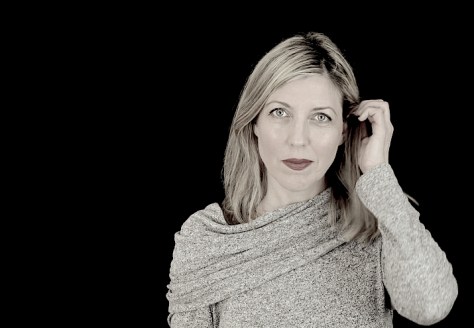 Kelli Russell Agodon’s most recent book, Hourglass Museum was a Finalist for the Washington State Book Awards. Her other books include The Daily Poet: Day-By-Day Prompts For Your Writing Practice and Letters from the Emily Dickinson Room, Winner of the Foreword Book of the Year Prize for poetry. Kelli is the cofounder of Two Sylvias Press.
Kelli describes her writing this way: “If someone walked into a fancy party in flip-flops, hugged a few guests, drank some champagne, opened the windows so wild birds could fly in and perch on the chandelier then took every one on a field trip to the cemetery, that would be my style.”
Kelli and Bekah connected via The 2018 Poet Bloggers Revival Tour, which Kelli started with Donna Vorreyer. We wanted to know more about her, her writing and the origins of #poetblogrevival, so here is our interview with her.
Q~Tell us a little about “Hunger.” How is it representative of your work?
A~I think this is one of the poems I am most known for, and I feel it’s a good representation of my work because it’s both dark and funny (well, I think it’s funny). Usually when I read it to an audience, they laugh when the narrator brings home the coyote and tells her lover she has a new pet, and then I hear gasps when we come to the part about that cat. As someone who grew up being told weird stories of deaths in my family, I was brought up with the idea that’s what life is—we’re all having a good time then someone dies. But, there is also love and humor. There are also people trying to be helpful and also making mistakes. Maybe my entire philosophy for life is in this poem—we want to be loved, we screw up, bad things sometimes happen, we do our best to go on, and we hope to have dinner together in the end.
Q~Why poetry?
A~Why love, why sex, why desire, why nature, why curiosity, why find art when the world is falling apart?
Our reality is where we look, so why not look to words, why not create? No one apologizes for watching sitcoms or organizing the shed, we shouldn’t even have to question poetry. Why poetry? Why not.
Q~What’s your writing process like?
A~Imagine the sky on a foggy day, then imagine the sun coming through the darkness, or the sun not coming through and an entire day of shade—that’s my writing process.
The majority of my poems are never submitted or published. I just enjoy writing and creating. When I wake up and the first thing I do is to write a poem, that is when I’m living my best life (as Oprah would say).
Q~What are your poetry likes and dislikes?
A~Likes: I love poets who write about relationships, desire, weird stuff, death, personal struggles, their own lives/issues, and who bring vulnerability to their work in whatever form or way they are dealing with it. I like inclusively, realizing we’re all at different parts of a journey and to respect and honor that. I like kind and helpful poets who help raise other poets up than to bring other poets down. I love poets who share poems, who interact with a large group of people and find ways to make the world a better place. I love to be surprised by poems and to see language used in interesting ways. I like visual poems and when poems appear in unexpected places. I like long walks on the beach with poetry and getting caught in the rain…
Dislikes: Ego. Author nametags. Poets who read over their time limit. Poets who only connect or support/like/retweet/respond to other poets because they feel they can help their career. I dislike exclusively in poetry and looking down at someone because they don’t have a degree or book, or looking up to someone because they do. I am not a fan of placing anyone on a pedestal and/or then knocking them off it. So, I guess I’m not a fan of pedestals. Though I do love trophies and honestly, most of the poets I’ve met have been sweet and kind, so my dislikes are probably limited to a small group (I hope they are limited to a small group…)
I think there is always more to love when it comes to poetry, both in our community and in learning about each other and ourselves through words and images. Honestly, I am just thankful every day that people keep falling in love with poetry and trying to write poems themselves. I always say the world would be a better place if everyone woke up and wrote a poem. Just imagine. I think it would be divine.
Q~Why did you and Donna decide to start the Poet Bloggers Revival Tour?
A~It was cold and dreary November . . . I believe it was Steven Schroeder and Charlie Jensen who first mentioned blogging on Twitter, and I got nostalgic. Blogging was my first poetry community with poets like C. Dale Young, Victoria Chang, January Gill O’Neil, Paul Guest, Aimee Nezhukumatathil, Eduardo Corral, Jeannine Hall Gailey, Mary Biddinger, Sandra Beasley, Oliver de la Paz, and so many others. I realized with Twitter and Facebook my community has grown large, but it’s different because so much of it is in short-form content (a tweet, a post, an update), but back then, we wrote these long paragraphs of our poetry lives, thoughts, fears, joys, to share with each other what was going on. It was sort of like sending poetry letters to each other.
You would read someone’s blog post and maybe continue the conversation on your blog. We’d link back and forth. It felt smaller and more intimate. I felt close to my blogger friends, even now when I share tweets or like Facebook posts, I tend to gravitate to my old blogger buddies because they feel like poets I know so much more.
I think we wanted to try to recreate that intimacy and connection by blogging once a week this year.
Q~Has it accomplished what you hoped?
A~Yes and no.
Yes, in that I feel reconnected with a lot of poets (and have “met” a lot of new poets) plus I am getting a new glimpse into their lives again.
No, in that I was planning on blogging once-a-week, and I haven’t kept that up just due to a very busy personal life this year. I’ve deactivated Facebook on and off all year and only use Twitter (and occasionally photos on Instagram), but my personal life has had me scrambling, so I realize how I once woke up and wrote a blog post, now I wake up and manage emails or am running out the door to work.
Bu,t the people who are blogging, are accomplishing what I hope—a deeper glimpse back into the lives of poets.
Q~Have there been any unexpected outcomes?
A~Guilt on my part for not keeping up. 😉
Q~In April, you mentioned that blogging was frustrating you a bit because of worrying that what you wrote wouldn’t be “good enough.” It reminded me of the article you wrote, “Submit Like A Man: How Women Writers Can Become More Successful.” Why do you think so many women struggle with this feeling of not being “good enough” and being afraid to put ourselves out there?
A~I can’t speak for all women, but as someone who grew up in the 70s & 80s, I know some of us saw our job as a girl was making people feel comfortable. If something happened or if someone was mad at us, the first question was “What did you do?” We worried about upsetting people. Sometimes we carried shame even for things that weren’t our fault.
I think there are many generations of women who grew up this way, always believing that they were the ones who did something wrong or that they could have been “better.” It was easy to internalize this voice and believe it. For a long time, I did. Even sharing this right now is uncomfortable because as I’m typing this I’m thinking, Am I explaining this well? Am I answering this correctly? Am I saying too much, not enough? There’s a perfectionism that can steer our lives, a worry, an anxiety.
It’s tough to put yourself out there, to be vulnerable. The world, the internet can be a challenging place if you are a sensitive person, it can feel like too much. This is when it may feel easier not to risk—you can avoid judgment by not sharing, writing, participating, etc. etc. But I don’t think that’s the best way around the feelings…
As a young woman, I remember never feeling good enough. As an adult woman, I still find myself feeling that way sometimes, but I’ve become easier on myself. I allow myself to try my best, knowing that my best won’t please some, and that’s okay. The goal is to finish; it doesn’t always have to be pretty, it just needs to be done.
The other quote I tell myself is “You only fail if you don’t try.” This takes away the outcome portion of whatever I’m afraid of doing, and it allows me to feel good about what I can control—the action. We cannot control the outcome of anything we strive for when other people are involved. I can send my best poems to a journal, but I cannot control if the editor will 1) Like them 2) Publish them. So, I’ve learned to stop worrying about it and focus on what I can control.
I also keep myself surrounded by people who support me. I cut ties with those who don’t. I’ve become much more aware when I’m feeling not “good enough,” and remind myself that the people I love and admire are not perfect. We are human, we will screw up—we just need to be easier on each other and ourselves.
Q~Any other advice do you want to share?
A~Trust your intuition. Put your own work before chores and email. Remember, in the big picture, none of this really matters. Have fun. Make love. Work hard. Choose joy. Prioritize your writing.
Q~How do you balance your time between your own writing and the work you do as an editor?
A~To be truthful, I don’t try to find balance or even believe that’s something we should strive for in life (especially women). Balance is one of those words that can make you feel not good enough. But maybe if we look at a life from beginning to end, we’d see balance, like Chaos theory, how small bits don’t make any sense on their own (and in fact seem well, chaotic, but if you look down from above you see a pattern. Maybe this is also our lives. But, I don’t strive for balance in daily life; I strive for being kind, helpful, and finishing tasks.
There are times of overload in one part of my life, then I meet with a friend to write poems, then I’m overwhelmed at work and only editing others’ work, then I have downtime, then I’m writing poems again, then there’s some sort of family issue, then I need to buy a new rug because my cats have completely clawed the heck out of mine, then I take a nap or stay up late, wash, rinse, repeat.
So, I guess my answer is that I don’t balance myself. I make time for what’s important which is my writing, my editorial work, and my family/friends—though not necessarily in that order. But I’m highly aware of my priorities, and I say yes to them and no to the things that do not add or fulfill me in life.
I do know if I start to feel resentment towards something—then I have had too much of I,t and I readjust. Maybe that is the “balance” you ask about, but it’s not really balancing, just readjusting my time so I don’t feel bitter. Maybe what people call balance is just creating a life where you don’t feel bitter or resentful, whatever that means to you.
But, I do make time for my own writing along with the tasks I have as an editor. Sometimes I like to be overwhelmed with my own work; it can really create some interesting poems!
Q~Where can readers go if they are interested in reading more of your work?
A~Check out Hunter’s Moon and How Damage Can Lead To Poetry on Waxwing, Shadowboxing Andy Warhol on VerseDaily, Braided Between the Broken in New England Review, and How Killer Blue Irises Spread in The Atlantic. You can also visit my homepage and connect with me on Facebook, Twitter, and Instagram.


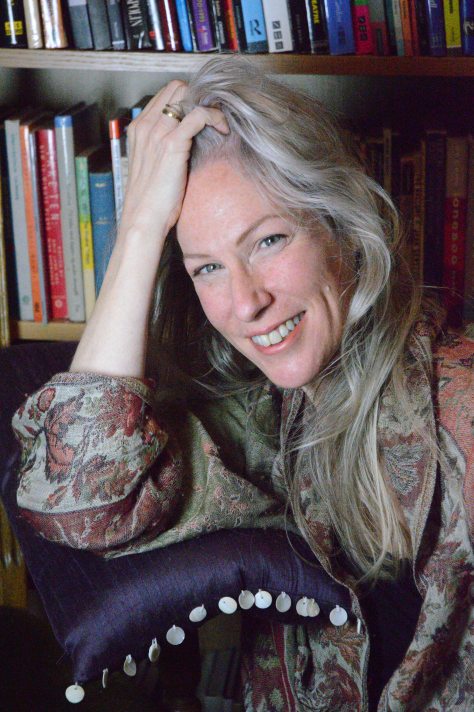 Ren Powell was born in California but has settled in Norway. She has six full-length collections of poetry, and more than two dozen books of translations. Her sixth collection The Elephants Have Been Singing All Along was published in 2017. Her poems have been translated and published in six languages.

 Crystal Ignatowski’s poetry has been featured or is forthcoming in Contemporary Haibun Online, One Sentence Poems, Tuck Magazine, Right Hand Pointing, and more. She lives and writes in Oregon.


 Risa Denenberg lives on the Olympic peninsula in Washington state where she works as a nurse practitioner. She is a co-founder and editor at Headmistress Press, publisher of LBT poetry. She has published three chapbooks and three full length collections of poetry, including Whirlwind @ Lesbos (Headmistress Press, 2016) and slight faith (MoonPath Press, 2018).
 Naomie Jean-Pierre is a MA literature candidate at City College of New York. She hails from Haiti by way of Atlanta. By day, she tutors high schoolers at Countee Cullen library of Central Harlem. By night, she versifies the raw material of daily life.
 Kay Bell has been published in the book Brown Molasses Sunday: An Anthology of Black Women Writers, Moko: Caribbean Arts and Letters, The Write Launch, as well as other venues. She considers herself a bibliophile and lives in the Bronx with her sons, Zaire and Morocco, and their tabby cat, Chad. Her website is

 Tiffany Shaw-Diaz is an award-winning poet who has been featured in Modern Haiku, Frogpond, Acorn, Presence, and dozens of other publications. She is the founder and director of


