Tag Archives: interview

When Trying to Return Home / an interview with poet Jennifer Maritza McCauley

When Trying to Return Home

by Jennifer Maritza McCauley

In the morning, I leave a panaderia on SW 137th
and a Miami browngirl sees my face
and says de dónde eres Miami or Not?
And I say Not, because I live in this blue city now
but she means where are your  parents from
and I tell her I have a Daddy who is Lou-born
and coal-dark and looks like me and I have a Mami
who is from Puerto Rico and looks like the trigena
in front of us who is buying piraquas for her yellow children.

The browngirl says eres Latina at least, and I say at least
in English. I look down at my skin, which is black, but
smells blue by the shores of Biscayne. She thinks my skin could
speak Spanish, a los menos. I want to tell the browngirl I was not born
by ocean rims or white-scuffed waves. I was not born
beside browngirls who speak Miami’s itchy Spanish. I was born
where my culture rarely bloomed—amongst Northern steel-dust and
dead skies, where my two-colored parents stuck out at any
Pittsburgh party. I want to tell her, I would love to be the type of girl
that says soy de Somewhere and everyone says, “Girl, I see”
or “you’re una de las nuestras
or “you belong.”

I want to tell her, you are right, in this blue city, I look like everybody
and everybody looks like me, and this is the thing I’ve always wanted:
to be in a crowd where nobody remembers my skin. I’ve wanted
this when I was a child, amongst grey buildings and steel-dust
where they called me unloved and weird-colored but here, mija,
I smell like blue and people who look like Mami can say funny
things like at least, at least.

Instead, I smile at the browngirl and she does not smile back.
Instead she says, in Spanish: If you are Latina, you should be so,
speak Spanish to me. And I say, in English: Yes, I could
but I am afraid, and she laughs in no language and judges me.

I want to tell her the history of my family-gods. They are rainforest-hot,
cropland-warm, dark with every-colored skin. They have mouths
that sound like all kinds of countries. I want to tell her these gods
live wild and holy in me, in white and blue cities where my skin
is remembered or forgotten, in cities where I am always one thing, or
from anywhere.

I want to tell the browngirl this while she turns and walks off.
I want to tell her that when she came to me, thinking I was hers
in that moment we were together,

at least.

First appeared in Aspasiology 2016.
IMG_0276

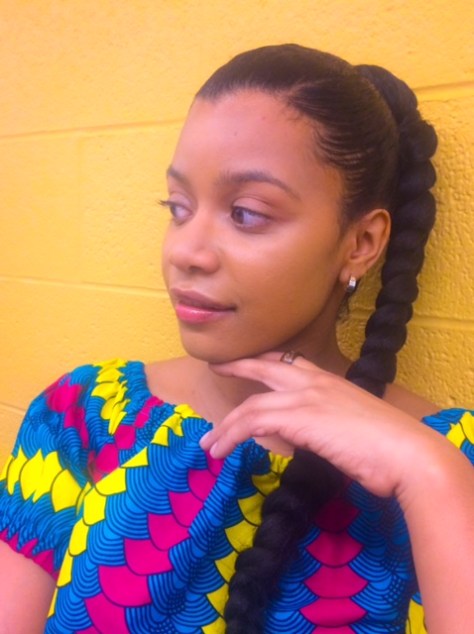
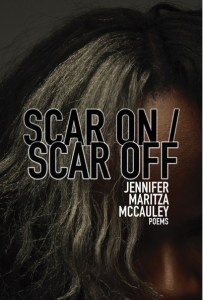
Jennifer Maritza McCauley teaches at the University of Missouri, where she is pursuing a PhD in creative writing. She is also Contest Editor at The Missouri Review and poetry editor at Origins Literary Journal. She has received fellowships from the NEA, CantoMundo, and Kimbilio. Her work appears in PleiadesColumbia Journal, Passages North, Puerto del Sol, and elsewhere. Her collection SCAR ON/SCAR OFF is available from Stalking Horse Press.

Jennifer says her style “depends on the subject matter, the genre I’m writing, or the speaker.” She says, “I enjoy free-verse and experimental poetry and I’m drawn to prose poem/lyric essay hybrids. With fiction or non-fiction, I like my narrative voice to fit the environment I’ve created. I generally have an interest in the pop and snap of language, and the intense focus on an image. I love playing around with linguistic mash-ups. My real-life voice code-switches often, and that impulse is reflected in my writing, I’m sure.”

Bekah and Jennifer connected after a review of Jennifer’s new collection, SCAR ON/SCAR OFF, appeared in the St. Louis Post Dispatch. We wanted to know more about this fellow Missouri poet and her writing, so here is our interview with Jennifer.

Q~Tell us a little about “WhenTrying to Return Home.” How is it representative of your work?

A~I’m interested in narrative poetry, how a poem moves, and how color holds literal and metaphorical meaning. In this poem, I wanted to tell multiple stories that explore the intersections of Afro-Latinidad, and issues of belonging, race, and cultural displacement.

Q~Did this poem come easily or was it hard to write? Is there a backstory you want to share?

A~It took some time! I wasn’t sure if I was ready to write about my own cultural disconnections yet. I was reading poetry that forced me out of my comfort zone, namely Nancy Morejon, and Cherrie Moraga, who are fearless. A few months later, I was asked to write a poem for Aspasiology in tribute to the wonderful poet Raquel Salas Rivera. I was inspired by Rivera’s poem  “suprasegmentacionalidades,” which has this terrific line “you are so much more than your translation. My jumping off point was thinking about how we are “more than our translation.” “When Trying to Return Home” (slowly) emerged soon after.

Q~What’s your writing process usually like?

A~Scattershot! Some pieces come out fast, others take years. I like writing late at night, and during writing sessions I warm up by reading something completely unrelated to my creative leanings. I’m a day-reader, and a night writer, unless I have a deadline. During the day, I’ll usually read work that is related to my research, composition exams, or creative writing. When I have a writing session, and I’m especially stuck, I like to read a short bit of something, but preferably unrelated to my project, sonically or subject-wise. I like my brain clear of direct influences. It might be a weird process, but the tension between me trying to figure out some problem on the page myself versus reading something unrelated to the project, helps me find my voice purely and gets the creative juices flowing. And most literature channels the human experience, so regardless I find access points and inspiration.

Before I started writing my historical novel, for example, which is set in the South during the Reconstruction Era, I spent much of my time reading as much Southern and period lit as I could, while doing on-site research and poring over history texts. During the actual writing sessions, when I hit a wall, I’d read Ezra Pound, Percival Everett or Pynchon. Completely unlike how I write and generally unrelated to the book. Before I write fiction, I often read poetry and vice versa. Many of the poems in SCAR ON/SCAR OFF I wrote at various times over the past few years, but before the actual writing sessions, I remember reading Lao Tzu passages,Octavia Butler interviews and Stanisław Lem, to name a few. I encourage my students to read outside of their interests, and I like doing the same. This isn’t a set rule for me during the writing process, but I find the trick helpful.

Q~In the review of your book in the Post Dispatch, they said you illustrate “with lyrical resonance how deeply intertwined family and social history can be.” Can you talk a little bit about the importance of this to you?

A~A through-line in my work, and especially in SCAR ON/SCAR OFF is how history, political landscapes, and familial ties influence who we become. I also like using poetry and lyric essays to explore subjects that are intensely personal to me. In this book, I wanted to examine how our ancestors, cultural communities and our connections to them reveal why we have scars, and how we heal them. It was important to me to pick apart my relationship to the collective, the personal, and the familial.

Q~Why did you choose the title, SCAR ON / SCAR OFF?

A~The title is a reference to the Rosa Parks quote: “Have you ever been hurt and the place tries to heal a bit, and you just pull the scar off of it over and over again.” The “you” and the “place” in that quote haunted me. Who the “you” and what the “place” of hurt could be, reflexively, generally and specifically. In Parks’ life, in the lives of my family, friends and communities, and in my life. I thought about why scars show up on our bodies, and when. We can ignore them, but still know they’re there. We can willfully pick at them or let them heal. The process of acknowledging, feeling bound to, or ignoring our pasts is its own kind of strength because we are taking back our agency. And, the scars that haunt our bodies might not be our own.

I was working on an essay about not liking my name and being distantly related to Rosa Parks and when I found that quote, I was inspired. My late friend, Monica A. Hand, wrote brilliantly about how the women we look up to linger forever in our lives in her poem “dear nina.” Her quote “The women I am from are wild; beautiful/This is what I know/When Lucille died, I tell my grand daughter/We are like Lucille trouble in the waters can’t kill us…” addresses scar-sharing and love, and the regenerative, healing power of connecting with our families, heroes, and children. The Parks and Hand quotes are epigraphs in the book. So, the title references ideas I wanted dig into in this collection.

Q~Who was your poetry first love?

A~Pablo Neruda, because my mother used to read his poetry to me as a kid, in Spanish and English. Toni Morrison, because her novels are like a tight hug; her prose is poetic.

Q~You’ve had a lot of experience editing literary journals including being a contest editor for the prestigious Missouri Review. What insights can you offer from this perspective?

A~I’ve been fortunate to work for journals with editors who give their staff, writers, and collaborators a great deal of creative space. In the editorial roles I’ve inhabited (The Missouri Review, Origins Literary Journal, Gulf Stream Magazine, The Florida Book Review, Sliver of Stone, and Fjords Review), there has been a genuine interest in developing the journal with the times, while maintaining a cohesive vision.

Working at The Missouri Review has been special. As Contest Editor, I coordinate our two annual contests, and, in the past, I’ve read general submissions and conducted audio interviews. Our editor Speer Morgan has a deep love for literature and enjoys talking to people about their day-to-day lives just as much as he loves reading. The whole staff is excited about what we publish and the submissions we read; it’s a fun, productive place to work.

Every journal has a different process for acceptance, and a unique vision for each issue. The Missouri Review has been around since 1978, and we get about 12,000 submissions per year. Submissions go through several rounds of review with interns and senior staff before they are published, and each contest has its own review procedures. There are many pieces that are almost accepted, but don’t make it for whatever reason. We don’t have room for everything we love, but writers who don’t get into TMR or place in the contest, often get into the journal later. We enjoy publishing unpublished, up-and-coming, and established writers. At the core Speer wants the essay, story, or poem to have an “about-ness” to it, that it can be analyzed from different angles and has something interesting to say about the human condition. At Origins, which is edited by the marvelous Dini Karasik, we like stories, poems, and essays that directly explore how identity and upbringing inform a literary work. I’m happy I worked for every literary journal I have, and I always encourage writers to read submissions for a magazine, literary agency or publishing house, even temporarily. You learn a lot about your own writing from the experience. And submit, submit, submit!

Q~There are lots of publications out there. What are some literary gems you feel deserve more attention? Why will we love them?

The Missouri Review is currently looking for submissions for our 11th annual audio contest, judged by Avery Trufelman. (Deadline, March 15). Origins Literary Journal is looking for submissions in all genres. Some of my other favorite journals are Pleiades, Queen Mob’s Teahouse, LunaLuna, Glass Poetry, Kenyon Review, PANK, Vinyl, Kweli, Chicago Quarterly Review,  The Journal, Sliver of Stone, Fjords Review, Gulf Stream Magazine, and TriQuarterly. My amazing friend Ashley M. Jones, is looking for submissions from Southern writers at Southern Humanities Review. These journals take an interest in writers from all backgrounds and styles, and the work they publish is consistently engaging.

Q~Where can readers go if they are interested in reading more of your work?

A~My book is available on Stalking Horse Press’s website, on Amazon.com. Links to my work are on my website. You can also find me on Twitter and Instagram.
Scar-On-Off-Store-Image

Addictions / The Ramingo’s Porch interview with Bekah Steimel

Addictions

by Bekah Steimel

as universal as love and math
as personal
as the scars of our secrets
we conjure the angels of amnesia
with a cocktail of spells
specific incantations
masquerading as pills
they appear just in time
always just in time
and we commandeer their wings
flying first class in clear skies
putting space and time
between us and our mummified memories
that refuse to rot
and crumble to ash
we rise when they do
strapping feathers to our wounds
until we lose altitude
and nose-dive back into reality

First appeared in The Ramingo’s Porch 2018
rp2coverdraftjeff2-copia

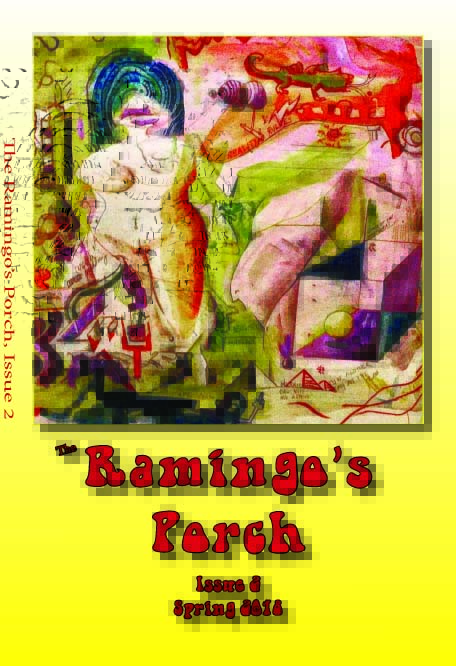
Four of Bekah’s poems–including the above poem–were recently published in the “Love, Spring & Revolution” issue of The Ramingo’s Porch. They also interviewed Bekah. Here is that interview.

Q~How long have you been writing? 

A~My Grandparents printed and framed a couple poems I wrote in fifth grade.  So, I have always been scribbling down my thoughts. But, I kept everything to myself.  I met my wife, who was an English teacher at the time, thirteen years ago.  I gradually began showing her all of my writing, and years later I am working on a poetry interview at 2 a.m.

Q~What do you consider to be your greatest accomplishment as a writer? 

A~Honesty.  I think my willingness to fix a spotlight on my struggles…to track them.. enables me to connect with readers in a really pure and gritty way.

Q~What projects of yours have been recently published? 

A~Since January, I’ve begun posting interviews on my website with female-identified and non-binary poets.

Q~Where can we find your work? 

A~I have links to my publishing credits on bekahsteimel.com, or you can Google me.

Q~How do you react to rejections?

A~I swipe it into a special rejection folder in my email.  I never read a rejection twice.

Q~How do you react when one of your submissions is accepted for publication? 

A~Celebratory casino trip

Q~What is your best piece of advice on how to stay sane as a writer? 

A~I would never advise that.  Writing is like some kind of padded room that it is safe to go bat shit crazy in.

Q~What is your favorite book? 

A~Jeanette Winterson’s Written on the Body

Q~What makes you laugh? 

A~Nothing makes me laugh harder than playing pranks on my wife. Sitting back and waiting for her reaction, trying not to laugh, is such a high for me.

Q~What makes you cry?

A~Missing my dog, Riley.

Q~What is your preferred drink while you write? 

A~Up until a few weeks ago when I was diagnosed with liver damage (no, really), it was vodka and Coke. Now, it’s just Coke.


See the interview here. Order a copy of The Ramingo’s Porch Issue #2.

One (In Two Parts) / An interview with Lyd Havens

One (In Two Parts)

by Lyd Havens

they call me rapid. water in the winter. fish stuck under the manic of me, gaping and slowly crimson. i’ve had four hours of sleep and i want to kiss the most typical of mouths—the mouths that don’t understand but are sympathetic. there is more to this. i dream of what i have never experienced with my eyes open. i see myself, and another girl. we are pressed against undressed pillows, hands grabbing at what does not feel real to me. i don’t know if there’s a word for that.

***

my mom says that during an episode, my laugh changes.she won’t explain how. i tell my therapist i don’t know how to distinguish mania from the ‘normal’, hyper-sexuality from the ‘growing up’, and she doesn’t explain how to solve this either. i’m left with too many comparisons for my body: jar full of loose change.guilt. pile of unfinished eulogies. again, the frozen river: trout beneath the becoming and the risks.i fall under the lullaby of the current, and i taste blood. i tap at the ice, and there is no one thereto explain how to get out. i feel my lungs peel back like citrus, and realize there is no such thing as reliable.

First published in Winter Tangerine 2016.

LydJan28Lyd Havens is the author of Survive Like the Water (Rising Phoenix Press, 2017) and the self-published chapbook Eight of Resilience. Their work has been published in Winter Tangerine, Cosmonauts Avenue, and Up the Staircase Quarterly, among others. They live and thrive in Boise, Idaho.
Lyd’s work was brought to our attention by poet Marisa Adame, whom we interviewed here. We offered Marisa the opportunity to “pay it forward” by choosing another poet to interview, and she chose Lyd. Marisa said, “Lyd Havens’ work stood out to me so strongly that I Googled their name to find more of their work before I’d even finished reading Winter Tangerine’s “Reshaping the Bell Jar” issue. Their piece struck me as the perfect balance of simple truth and vivid imagery—that is, the poem had the ornamentation of metaphor while still communicating specific details of the story. I felt I had a lot to learn.”

So, here is Marisa’s interview with Lyd.

Q~How would you describe your style?

A~My style is conversational and vivid. Any poem I write is being read aloud as it’s being written, and I’m always trying to write things that work well both being read and being heard. I don’t know whether this is because I first started writing poetry while participating in poetry slams (which I still do), or because so many of my poems are born out of different conversations I have with different people I love, but my poems feel like an extension of my daily speech patterns. I’m just usually a lot more eloquent in my poetry.

Q~Tell me about “One (In Two Parts)” and what drew you to the Winter Tangerine theme, “Reshaping the Bell Jar”?

A~One (In Two Parts) is about having Bipolar I and is one of the only poems that I’ve written about that (still, even two years after it was written and published). It was actually fairly easy to write, all things considered—a lot of the images about a frozen body of water were from a dream I had as I was coming down from a manic episode, and I wrote the whole poem in one sitting (which doesn’t always happen with me). After I finished it, I immediately knew I was going to submit it to the “Reshaping the Bell Jar” issue of Winter Tangerine. I’ve worked with WT a lot over the years (I was an intern for them in 2013, and was a reader for another one of their themed issues, “Fragments of Persephone”), and that particular theme was incredibly important to me. It’s probably one of the most important (to me) poems that I’ve ever written, and finding out it means something to others is always so wonderful, especially considering how infrequently Bipolar Disorder is talked about anywhere.

Q~What’s your writing process like?

A~Almost every poem of mine starts with a single image or sentence that pops into my head, and then I go from there. As I mentioned earlier, most of my poems aren’t finished in one sitting. It can take anywhere from a few hours in the span of a day to three months for anything I write to be truly “finished.” I also have to read the poem out loud as I go on writing it, so as it’s being written, I’m also usually playing around with diction, tone, volume, speed, and other performance aspects. I can write pretty much anywhere, but I have to finish poems in private and alone.

Q~What’s one piece of advice you want to share?

A~Give your poems time, and give yourself time. I feel like poems can be pretty stubborn things, and sometimes the timing just isn’t right getting one out, whether it’s because of the subject matter or your own headspace. I’m a huge advocate for never forcing anything, especially poems. You’ll get there when you get there, and when you do, it’ll be better than anything you would have had to pressure out of yourself.

 Q~Are you involved in your local poetry scene? What’s it like?

A~I’m very involved in the poetry scene in Boise, and I absolutely love it! There are two poetry slams every month, and they’re always just the most amazing time. There’s also a literary festival every month that’s in association with the Treefort Music Festival, Storyfort. It’s coming up in March, and there are all sorts of readings and panels planned that I’m so, so excited about. It’s definitely a smaller community, but incredibly welcoming and kind and fun. I absolutely love being a part of it.

Q~What drew you to slam poetry? 

A~I first started competing in poetry slams when I was about 15, and at the time I was really shy while simultaneously having a lot to say. Past traumas had left me feeling like I couldn’t ever be heard, but after seeing a flyer for a slam in my hometown, I thought that that might be a good outlet for that. Slams have a very special kind of vulnerability to them—it’s passionate, versatile, and honestly thrilling. Poetry slams helped me learn how to use my voice.

Q~Who are you reading now?

A~I just finished Whereas by Layli Long Solider, which is an absolutely spectacular collection that challenges the “expectations” of language, and a lot of the documentation (or lack thereof) of how the United States government has treated indigenous peoples. I also recently finished Hanif Abdurraqib’s collection of essays, They Can’t Kill Us Until They Kill Us. He’s one of my favorite poets, and this collection is probably one of the best things I’ve read in a long time (maybe my whole life). I’m currently reading When I Grow Up I Want to Be a List of Further Possibilities by Chen Chen, Just Kids by Patti Smith, Words in Your Face: A Guided Tour Through Twenty Years of the New York City Poetry Slam by Cristin O’Keefe Aptowicz, and a lot of singular poems by my friends or that my friends recommend (one recent example: “Ode to Mennel Ibtissam Singing Hallelujah on The Voice (France), Translated in Arabic” by George Abraham).

Q~Where can readers go if they are interested in reading more of your work?

A~My website is www.lydhavens.com I’m also on Twitter and Instagram 

Q~Is there anything else you’d like us to know?

8oREtsy1A~I just self-published a small chapbook full of poems about joy, healing, and gratitude, which is for sale here. It’s probably the most special project I’ve put together, and the covers on the physical copies are all hand-painted! Also, I’m going to be reading poems sort of all over the place in the US this year. There’s a whole list of dates on my website under “Events”—if any reader can go to any of them, I’d love to see them there! Please come say hi 🙂

marisa

Marisa Adame, storyteller/creative from Dallas, Texas, values work that balances as much as it deconstructs. Her work has appeared in Crab Fat Magazine, Red Savina Review, Hold the Line, and St. Sucia zine. You can find her on YouTubeInstagramFacebook, and at marisaadame.com.

seedling story / An interview with Marisa Adame

seedling story

by Marisa Adame

bones of my resentment rest under loose dirt
that cascades when i open my fingertips.

ivory justice,
buried after far too long; the rattling of not good enough
shook my skeleton since i joined ranks with too-skinny girls.

they live there, the bones, under soft soil
aching to metamorphose into self-confidence.
they grew from the teardrops that seeped in every day after school.

the ground gurgles. my feet catch the vibrations.
bones shift–
catch rock // grow roots //
shy shoots shiver in the blowing wind.

at age 18, my first hook-up comments on my wide hips
and the curvature of my shadow. i hear the bones
rattle in the dry dirt of Texas and realize they are still there:
tears well // earth shifts //

curse,
cry,
shiver.

the not good enough rattles my bone structure,
goosebumps stick out of my skin.

i thought i had paid off my dues
but the seedling structures
rupturing the ground
tell me i still have far to go.

some days are harder than others, but
the growing has already begun.

First published in Free Lit Magazine 2018.

marisa 

Marisa Adame is a 22-year-old storyteller/creative from Dallas, Texas.  She has acted internationally and is a two-time KCACTF Irene Ryan Acting Scholarship nominee. Her manuscript butterfly bombs, an examination of Latinidad as a first-generation-college student, was a finalist in Thoughtcrime Press’s 2017 Lorien Prize competition. Her current projects are a stage play exploring the tension between her colonizer/colonized bloodlines and a choreopoem weaving together themes of time, queerness, heritage, and mental health.

As for her style, she says, “I would say that I like surrealism, and I have a bias for narrative. I try to make my work imagery-driven, so the audience has to put themselves in the world of the poem to see how everything connects. I think the work I aim to create could be called bittersweet, since it’s a little more cynical but finds optimism to balance it out.”

Marisa and Bekah’s work–including the above poem–appeared together recently in Free Lit Magazine’s “Bildungsroman” issue. We wanted to know more about Marisa and her writing, so here is our interview with her.

Q~Tell us a little about “seedling story.” Is there a backstory you want to share?

A~I went to an all-girls’ high school, and I picked up some distorted thinking surrounding relationships with food/body image. I feel our culture’s tendency to tell women, particularly women of color, that our bodies are somehow inadequate is essential to keep in mind while reading. Another thing to keep in mind is the truth that some experiences aren’t something to get over as much as to navigate and re-navigate over time.

Q~How is the poem representative of your work?

A~“seedling story” is representative of my work as a piece that uses pain to excavate hope. Like much of my work, it moves through heavy moments instead of discarding them, and it tries to hit that balance of sadness and joy. It’s about the strength that comes through trial, which I value and put into my writing.

Q~Why do you write poetry?

A~I gravitated toward poetry because of its visual nature. I’ve always loved writing and finding the strongest words to describe events/feelings, and poetry came as a natural practice; once I started, I couldn’t stop. With poetry, you can guide and influence the audience. You, the author, decide when a line gets space to breathe. Also, poetry is specific to the author’s truth yet still malleable to audience interpretation, but more ambiguity is acceptable in poetry where it may not be acceptable in other writing styles. Also, poetry lends itself easily to unconventional imagery and wordplay, so it gives plenty opportunity to see things in fresh and new ways.  

Q~You are also an actress & filmmaker. How do you balance your creative interests? How do they interplay?

A~Balance between all of my creative interests is something I’m still struggling to find! But I’ve found a pretty good set-up for now. Un/fortunately, I’ve been moving around a good bit recently and haven’t quite found a long-term base, so acting has taken a backseat. I’ve applied to a few agencies that may be open to working with someone semi-nomadic like me, and I’m waiting to hear back from them. Otherwise, I use one of my days off from work as a creative day split in half: mornings for writing projects and afternoons for film projects.

My creative interests definitely interplay! As an actress, I tend to gravitate toward more poetic scripts like References to Salvador Dalí Make Me Hot by José Rivera. I think my spoken word poetry background makes it easier for me to understand a character who speaks in metaphor. Filmmaking shares a lot with poetry as its power often comes from what is not said or shown, or what is only implied. Again, my poetry aims to be visual, almost like film in a way, and I think that’s because I’m a visual person. I aim to make poetic films someday, and I’m currently working on a screenplay that uses magical realism.

Q~Do you find yourself returning to certain themes or subjects in your work? What are they and why do they resonate with you?

A~I find the main themes I return to are mental health and legacy. My first two chapbook manuscripts dissect my mental health diagnosis and my relationship with others with mental health challenges. Because mental health does affect every aspect of life, it’s important to me to speak about it and work against stigma surrounding it. I feel the need to be very vocal about it because of the silence and stigma still surrounding mental disorders in Latinx communities, particularly the one I grew up in. I feel I wasted a lot of time feeling like something was wrong with me, and I find it important to write to let others like me know they’re not alone. Legacy is also interesting to me to explore, particularly definitions from others and from oneself. I feel most satisfied writing about the complexity of my heritage and am currently working on a few projects questioning my relationship to the colonizer/colonized sides of my family tree. I think a lot about when to use language, and when to use stillness, so I often edit and edit until the rhythm of a poem is evident on page. Some images I return to frequently are surrealism and dreams, and water and all of the implications they can have.

Q~What are your poetry likes/dislikes?

A~I love poetry that risks something. The poems that resonate most with me are from artists who are honest about who they are, where they’ve been, and how that’s shaped them into who they are now. I love poems that transport you to a new place and make you look at the world in a new way. I love poems that are worlds in and of themselves, that make you forget where you’re sitting as you read them. Some favorites are: “The Survival of What Remains” and “The Law of Halves as Applied to the Blade” by Michael Lee, “From the Desire Field” by Natalie Diaz, “Tell Them”  by Carvens Lissaint, and Said The Manic To The Muse by Jeanann Verlee. I also love: “As of today, I have yet to put my hands on the volcano of my dreams.” by Joe Jiménez. I dislike poems that are obvious, and that prioritize raw feeling over craft. I dislike work that reads like a personal essay but calls itself poetry even when it has no imagery. I dislike poetry that uses trends for quick one-liners then discards them without making a larger statement or observation.

Q~What’s one piece of writing advice you want to share?

A~Practice finishing. Finishing projects, or even just drafts, is a skill, and you get better with practice. Follow an idea through until something is made. Even if you don’t do anything with it, you’ll have made it, and you’ll feel more capable to try again.

Q~There are lots of publications out there. What is a literary gem you feel deserves more attention? Why will we love it?

A~I highly recommend Winter Tangerine’s Reshaping the Bell Jar issue. A one-time occurrence to my knowledge, the issue is centered around “Illuminating Realities of Mental Illness” and features contributions from poets with mental disorders to reform the narratives surrounding various diagnoses. It’s a beautiful, poignant, well-crafted issue full of tremendous work.

Q~Who are you reading now?

A~I recently read and am still digesting Caitlin Scarano’s debut work, Do Not Bring Him Water from Write Bloody Publishing. The work is a story of haunt, heart, and grit. I was amazed from start to finish. She shares stories of trauma through the use of powerful and breathtaking images, and the result is a gripping book. It’s been receiving well-deserved high praise.

Q~Where can readers go if they are interested in reading more of your work?

 A~ I put direct links to publications, whether online or in-print, on my website at marisaadame.com. One of my earliest acceptances came from Crab Fat Magazine, and my work can be found under my name. You can also find me on YouTube, Instagram, and on my official Facebook page.

We Surrender Our Dreams to Hunger / an interview with poet Sarah Kain Gutowski

We Surrender Our Dreams to Hunger

by Sarah Kain Gutowski

The woman doesn’t want to eat the bird, or the moth,
or swath her tongue in gnats or fruit flies.

Her tongue will not bend the way her mind dictates, in the way
her arm, sometimes late at night, abdicates the bed’s realm

and travels through the forest on its own. She feels a kind of static
where it used to lie, like a cloud of bees buzzing at her shoulder.

She dreams that her dismembered arm, a white branch stark
against the dark oak leaves, swings between the trees

and then crawls on its fingertips along the ground.
Her nail beds fill with black, wet earth. Her forearm glows

with the nighttime’s condensation: a slick, pale ember
in the moon’s occasional light. Beams push through the forest canopy,

highlight the crook of her elbow bent above a spider’s lattice,
or hooked around a clump of brush. Her arm, absent from sleep,

has great adventures. And then she wakes and shifts her weight,
only to discover something cold and clammy in the sheets beside her,

a lump of flesh she cannot call her own. Her other arm,
the one remaining in her bed, loyal until the end,

investigates by lifting the offending, foreign object
and then, in shock, dropping it.  It slaps against the mattress

and then the pain begins, the necessary hurt that comes
with reattachment. The cloud of bees lengthens and attacks,

a hundred stingers lodged inside her skin, and dissipates
like fog obscured by burning sun. And then she is aware

that her arm was always there, by her side,
and neither part, arm or mind, is happy when she awakes.

author photo

Sarah Kain Gutowski is the author of Fabulous Beast: The Sow (Hyacinth Girl Press) and a Professor of English at Suffolk County Community College, where she teaches writing and literature. Her writing has been published most recently in Phantom Drift: A Journal of New Fabulism and Painted Bride Quarterly.

She says it’s difficult to describe her style: “I’m certainly not experimental although I’m constantly trying new-for-me things in my work. I write a good deal of free verse, but I’m very interested in forms and what those restrictions can do for me in the act of creation, and how ultimately the form will support any kind of meaning.”

Sarah and Bekah connected through the 2018 Poet Bloggers Revival Tour. We wanted to know more about Sarah and her writing, so here is our interview with her.

Q~Tell us a little about “We Surrender Our Dreams to Hunger.” How is it representative of your work?

A~This is from a fairy tale I wrote mostly with Spenserian stanzas but occasionally with these free verse poem “breaks” – kind of like the way a child interrupts a story with her questions as the parent reads to her. I like longer works, series of lyric poems that can tell a narrative. I’m a little in love with narrative.

Q~Is there a backstory you want to share?

A~This poem, the woman mentioned in it, is the protagonist of the fairy tale, a woman with a frog tongue who goes the way most (non-Disney) fairy tale heroines go – transformed through her trials, for better or for worse.

Currently, I’m making a poetry video out of this poem with one of my colleagues, Paul Turano, who’s a film editor and all around fantastic guy. He’s very patient with the fact that I have big ideas but little idea of how to execute them. The video **might** be ready by the end of April.

Q~Did the poem come easily to you or was it hard to write?

A~It came more easily than the rest of the fairy tale, partially because it was “triggered” by a question from my eldest daughter, to whom I was reading the fairy tale as I was creating it. She asked me, “Mama, couldn’t she eat a fly? Because she has a frog tongue.”

And, this was the weird answer that came out.

Q~What appeals to you about fairy tales?

A~Fairy tales — as a part of traditional literature like fable and myth, intended to explain our world while keeping us entertained by it —  pair the violently weird and inexplicable with attempts at constructing or exemplifying a moral code — and because fairy tales attempt these two things at the same time, they’re always going to fail in one way but succeed in another. I guess that’s what appeals to me — the mixture of failure and success, the way they demonstrate how human we are (while often employing inhuman, magical characters). The weird, violent side of fairy tales has always fascinated me and fascinates many writers. There are so many good fairy tales out there. Have you seen Del Toro’s The Shape of Water? It follows Vladmir Propp’s morphology of the fairy tale exactly — it’s so good. (Maybe not as good as Pan’s Labyrinth — that film is exquisite —  but it’s pretty damn good.)

Q~Who was your poetry first love?

A~Anne Sexton. I still feel like no one writes weird the way Sexton does. I don’t return to her as much as I do my later loves (Bishop, James Wright, Glück, Walcott), but I love the strangeness of her metaphors and images and the way they also make a bodily – visceral – sense to me. The acknowledgment and value of physical sensation that’s present in Sexton’s work – the way it’s as important as emotions and intellect in our very makeup, our personhood – is probably something I’ve always gravitated toward in all poetry. It’s something I strive to include and address with my own writing . . . so I’d say she made a pretty big impression on me.

Q~I’d say you accomplished that visceral quality in “We Surrender Our Dreams to Hunger” with the dismembered arm. Who are you reading now?

A~Ashley M. Jone’s debut collection of poems, Magic City Gospel. She’s going to be the featured reader at a creative writing festival we hold at Suffolk in the spring, and her work is a fantastic deconstruction of personal history, the history of the South, and contemporary politics – laying bare the complex connections between all three. I’m also rereading Amy Leach’s book of funny, whimsical, super smart essays, Things That Are, because the collection brings me so much joy. Also also, I’m finishing up J. Marc Harding’s wonderful, dark novel, Drowning in Sand. Also also also, I’m 1/8 into about fifteen different books because I WANT TO READ ALL OF THE THINGS, AND I DON’T HAVE TIME. Ahem.

Q~You’ve been applying for writing residencies. What is the appeal? What do you think it will do for your writing?

A~The appeal is tenfold right now. I teach full-time, I run a couple of different projects at the college, and I have a husband and three children. I’ve built a very full and amazing life with the college and my family, but it often means that quiet time, reflective time – which is very important to me personally and essential to my writing – is scarce. I try to carve it out regularly, in mornings before kids wake up, occasionally at night after everyone’s in bed, but deep work — becoming totally and wholly immersed in creation – doesn’t happen often, and it’s something that’s also necessary (for me) for larger projects, like the play I’ve been working on for ** gulp ** almost seven years. So . . . the appeal is the solace, the quiet, the opportunity for thinking and working. In the end, I hope residencies will allow me to draft. I can revise like a champ with all of the other life-stuff happening around me. But drafting, for me, needs alone-ness. A lot of it.

Q~How has being a college instructor changed your own writing?

A~It’s kept me very engaged with the work of other writers and artists and thinking about craft and how and why I make the choices I make with my writing. I may not have as much time to put pen to paper as I’d like, but because of my teaching I’m constantly thinking about the purpose and function and effects of what we write, and how what we write is part of a larger conversation with the work of our contemporaries, the work of writers in the past, and the work of future writers. These are issues I bring to my students with each class, be it a writing or a literature class. And, then when I do have time to put pen to paper, all of these thoughts shape my writing, or are contained within the writing itself.

Q~What’s one piece of advice you want to share?

A~I’m still working on dealing with rejection myself, but a genuine focus on process over product helps. You really cannot help whether or not other people want to invest time and energy in your work. But, you can control the time and energy YOU invest in your work, to an extent; and if you’re putting time and energy into the work, you damn well better derive genuine joy and energy from the act of writing. If you don’t, you’re going to end up with a bitter, small inner life dominated by resentment. (I’ve been near that precipice before – I try to be conscious of staying as far from it as I can.)

Celebrating – again, genuinely – the work of other writers helps, too. It’s a good reminder that shared writing is part of a larger conversation, and that we can’t all speak at the same time, or nothing is heard.

Q~There are lots of publications out there. What are some literary gems you feel deserve more attention? Why will we love them?

A~BOMB magazine is amazing. A quick disclaimer – I am not always in love with their choices when they publish poetry or fiction. But, I absolutely adore their conversations between thinkers and creatives. I began reading BOMB in college, and it blew my little mind. You can be a poet and still find their interviews with architects and sculptors completely and wholly relevant and inspiring.

The Threepenny Review is also phenomenal. It may be “establishment” because it’s one of the oldest literary magazines in the states, and traditional/older lit mags may not print much work that challenges aesthetic norms (and, you know, sometimes that’s what you might be looking for), but it’s unsurpassed in its ability to make connections between ideas and various art forms, bringing together tremendous writers and thinkers and visual artists in each issue. The regular Symposium feature is one of my favorite things ever.

Q~Where can readers go if they are interested in reading more of your work?

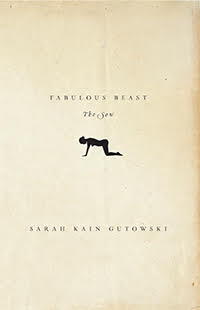
A~My web site has links to projects I’m involved with, like an online New Hive collaboration, as well to the journals I’ve been printed in. I’m also on Twitter, Facebook, and Instagram. Readers might also check out the link to my chapbook publisher, Hyacinth Girl Press. I’d love it if they bought copies of Fabulous Beast: The Sow, of course, but there are so many other good authors whose chapbooks have homes there. The press is worth checking out and supporting.

skgbook

Cloud / An interview with poet Ally Malinenko

Cloud

by Ally Malinenko

I’m staring at that word
printed on an ad on the subway.
I’m not even sure what the rest of the ad
says or what it’s trying to sell just the word
cloud
the way it has loud in it

you’re a fucking bitch
you hear me you little bitch

I want to turn the volume up
in my headphones but everything
is locked. I will not move my arms
or my lips or my eyes.
I will not turn up the volume in my headphones
even though I don’t want to hear him.

I love telling bitches to suck my dick

He’s close enough that I think I can feel his breath
on my cheek
feel his hatred against my skin
I think
if he touches me
make a fist
thumb out
knuckles tilted down.
Go for the throat
and then run

Cloud
like loud
I sound it out in my head

Run
Run
Punch and then run
to the other end of the subway car
but what if he catches me?
Keep punching.
Punch once and keep punching.

Suck my dick bitch
You fucking bitch

The train is nearly empty
though I make eye contact with the woman seated
in front of me
for a brief moment
her eyes say

I’m sorry,
I’m so sorry
but I can’t help you

before they flit away

You fucking bitch.

He hisses and I am frozen
like a deer in headlights
like a small useless thing
my teeth locked together
biting down hard
waiting for the doors to open
thinking

punch and run

cloud like loud.

He is not big
scrawny even
and my height

Out of the corner of my eye
I see his hands curl into fists
and I look back quickly at the ad
cloud
like loud
punch and run
suddenly
knowing
he and I are thinking the same thing

First published in Paper and Ink Zine 2018.

ally malinenko photo

Ally Malinenko is the author of the poetry collections, The Wanting Bone, How to Be An American, Better Luck Next Year and Fitting the Ocean in Your Mouth as well as the novel, This Is Sarah. She lives in Brooklyn and tweets a lot about David Bowie and Doctor Who.

She describes her style as “narrative, usually first person and as straight forward as I can manage.” She says, “I don’t usually go for flowery descriptions. I try to cut to the chase though I’m sure I fail at that.”

Ally and Bekah’s work–including the above poem–appeared together recently in Paper and Ink Zine’s all-female issue, “Girls to the Front.” We wanted to know more about Ally and her writing, so here is our interview with her.

Q~Tell us about your poem, “Cloud.” It’s really evocative. Is there a backstory you want to share?

A~Everything in this poem actually happened. It was on the 2 train on my way home from work. There was a super aggressive guy on the train saying all the things he says in the poem. The MTA in NYC had this initiative where they published poems with accompanying artwork in train cars. The poem that I was staring at when he was saying all of this was called “Cloud.” I don’t remember who wrote it or anything else about it. I don’t know why I changed it to an advertisement in the poem. For some reason that seemed easier. All I remember is that word and this man’s aggression and my own fear. There was another older woman there who I did briefly make eye contact with. I was only on the train with him for two stops, but it felt like a lifetime. When the doors opened at my stop I practically ran through the station.

Q~How is the poem representative of your work?

A~In the sense that it is a narrative, yes, it is pretty representative of my poetry. Because I am also a novelist most of my writing is an account of events, some real, some not. I write a lot about moving through the world as a woman from a feminist standpoint both to honor the good work that feminism has done and also to hold up a mirror to where it has failed women.

Q~What can you tell us about your current project for Women’s History Month?

A~John Grochalski has been running a resistance blog since Trump’s election. Every day he posts a piece of artwork–a poem, a story, a picture, what have you–as a means to combat the darkness. At the end of each week he includes a wrap up of what went down that week politically. In March he’s handing the reigns over to me so consider this my sincere plea for art. Creative women and women-identifying persons everywhere should send their work to winedrunksidewalk@gmail.com with the word “MARCH” in the subject heading, so I can feature them on the blog. There are no limitations to what you can talk about, but it would be amazing if for the month of March it was focused on elevating women’s voices and experiences. So, it doesn’t have to be about politics but anything about what it is like to navigate this world as a self-identified woman. Submission information is here. In times of uncertainty art can be both a sword and a shield. Art has the power to wake people up, alter their path, shake them into awareness. Pieces can be previously published, too; just give me a heads up as to where so I can credit them. John has kept this thing running for over a year, and I’m honored that he trusts me not to screw it up in March. In order to do that I need everyone reading this to please, please, please submit!

Q~What is the time frame for sending you submissions for the resistance blog?

A~There really isn’t. It’s an ongoing thing. Basically send something, and it will show up on the blog at some point. For March the sooner, the better because I’ve got to fill 31 days, and I really don’t want those 31 days to be the “Ally Show,” so I’ll take whatever people have got when they send it. And, I should stress that John is always taking submissions so even if they don’t get something in by March for Women’s History, he’s always looking for more women and POC and non-binary folks to fill the blog. He’s posting something every day for as long as that idiot is in the White House so….

Q~How does this relate to the poet’s role in society?

A~That’s an interesting question, considering the times we are living in. I think in general it’s the same as any writer–-to document our time. To hold a mirror up to humanity. To remind us who we were, who we are and who we have the potential to become. I think art has power, and writing has power, and the great thing about poetry is that simplicity of it. There’s a whole novel there in each and every one. Good poetry is a knife point that cuts right through the nonsense. And, right now there is a lot of nonsense. And, on the flipside, I think the amazing thing about art is that it is transformative. It can take us away from the nonsense, transport us, if only temporarily somewhere else–somewhere beautiful and peaceful. It works both ways. I think every poet should know that she carries those two possibilities every time she sits down to put words to paper.

Q~Why do you personally choose to write poetry?

A~I feel like even though I write prose and speculative fiction my inner voice sounds the most like my poetry voice. And, I started writing it as a teenager as I’m sure many poets did, so it’s just been something that I have been doing for a long time. Because so much of what I write is confessional and based on my life I find poetry really cathartic. I was diagnosed with cancer back in 2014, and unable to manage this huge crack in my life I turned to writing. I wrote poems about the whole experience, and that eventually turned into my book, Better Luck Next Year. In all honesty, being able to write about what was happening through poetry helped to keep me sane. Writing has always been there for me like that.

Q~Do you find yourself returning to certain themes or subjects in your work?

A~I write a lot of about death, or more so, the incredible luck it is that you are even alive to begin with, how everything had to go perfectly right since the very beginning of time. Sort of like Mary Oliver’s “Tell me, what is it you plan to do with your one wild and precious life?” I use writing as a means of connection. I throw something out in the world and see if it resonates with anyone else. I’m basically saying, “Hey I feel this. Do you feel it, too?” Whenever that happens I feel like this human web gets a little bit tighter, a little bit stronger. Against all obvious signs I still believe in the goodness of people.

Q~Are you involved in your local poetry scene?

A~Honestly, I’m not. I’ve done some readings in Brooklyn–a whole lot more in Pittsburgh where I went to college and maintain some close friendships–but scenes in general always made me uncomfortable. I don’t particularly like reading. I don’t like being on stage and being looked at. No matter how many readings I do, my hands still shake like it’s the first time. Sometimes I wonder if it’s because the stuff that I usually write poetry about is so personal that I just feel like a fool up there. I might as well be reading out of my journal! When I do readings in Pittsburgh and see my friends, who are also all writers, it doesn’t feel so much like a scene as it does a bunch of people hanging out, drinking, listening to records and talking about books and movies and music. Maybe that is a scene, I don’t know.

Q~Who was your poetry first love?

A~Anne Sexton. Definitely. I jokingly refer to her as my mother. The confessional style that she used to cut right down to the heart of everything I had wanted to say. I read her as a teenager, and she legitimized what I had been scribbling down in secret. She made it okay to say it out loud. She became a gateway drug to Sylvia Plath, Adrienne Rich, Sharon Olds and down to my current obsession, Marie Howe. Howe is my hero and everything I aspire to be.

Q~What is it about Marie Howe and her work that you love and want to emulate?

A~I don’t know. I struggle a lot with poets. It’s strange because I love it, and I love to write it but often I have trouble finding people that I love to read which is terrible when it comes to looking for inspiration. When my husband gave me Marie’s first book, I couldn’t stop reading it. I walked through the subway at Atlantic Station reading it, and honestly if you know how awful Atlantic Station is and how much I hate people who meander in the subway, you’d understand how huge that is. Every line just seemed to cut right through me. Her book What the Living Do is powerful as hell. She’s got this poem in it about how if she could go back in time and see herself as a little girl she knows that girl would never come into her arms, would never trust her enough. As if even as a little girl she was still a woman with a woman’s sense of caution, fearing even herself. I just really related to that. And, her poems about her brother dying of AIDS would gut anyone. I’m just saying, very few poets have made me cry. Go read the poem “The Last Time” about her brother confronting her about death and her insistence that she understood that he was going to die. It’s short–maybe 10 lines–but the end is an absolute punch in the stomach. I won’t ruin it because it’s that good. I read that poem and thought about that poem and realized that is the kind of poetry I had been trying to write my whole life. Something that opens you up, makes you feel comfortable or familiar and then by the end, flips it on its head. And, then even the mundane, the way she writes about a cheese and mustard sandwich, the messy parts of living, of what it means to pass through one day after another, how we balance that mundane with the knowledge that all of this is going to end forever. She does it like no one else. I just wish she would write a book more than once a decade, but that’s just cause I’m greedy.

Q~What’s one piece of advice you want to share?

A~I don’t know if this is really advice as much as what I practice. I’m a big believer in my schedule. I get up every weekday morning at 4:45 am, and I write until I need to start getting ready for work around 7:15. I’ve been doing this for over ten years–my husband who is also a writer, started this plan–and I really feel like it works. There is no way I could have produced four books of poetry and three novels without it. I guess something has to be sacrificed to the muse, right? I chose sleep.

Q~What’s it like being married to another writer?

A~Oddly enough other than complaining about being short on ideas, we don’t really talk about it that much. We’re very different writers even though we’re both poets and novelists. There was a small period of time where I wanted us to share notes and give feedback on each other’s work. I wanted to blend this part of our lives together, and it was an absolute disaster. I tortured the poor boy. We’ve both got really strong personalities and really strong writing voices, so it turned into this thing where I would be like, “Well if I wrote it….” and it was a mess. Because I didn’t write it. He did. And I needed to respect that. I think most creatives who are in long relationships with other creatives discover that you need to keep the relationship and the work separate sometimes. I don’t think it’s a terribly good idea for your writer-partner to be critiquing your work. I think you need less involved sources. On the flip side, it’s really fantastic to have someone to bitch with. To complain about magazines going under or who rejected your work. I mean writers can be petty as hell, so it’s nice to have someone on your side in the trenches. I respect what he does, and he respects what I do, and we support each other. But, we’re not a writing circle. Hell, no.

Q~Where can readers go if they are interested in reading more of your work?

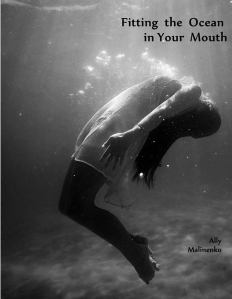
A~Pretty much everything is on my website. I also tweet (probably too much) at @allymalinenko, and I’m on Instagram and FB and all the other social media things. And, at the end of the day a Google search will pull up a pretty fair idea of what I do. You can also purchase my latest poetry book, Fitting the Ocean in Your Mouth, here.

Fitting the Ocean in Your Mouth cover


Restless / An interview with poet M.J. Iuppa

Restless

by M.J. Iuppa

Overhead, clouds billow
in wind that can’t seem
to settle on one direction.
They hesitate in the way
we hesitate in the skip
of thought–a pause

that sinks like a small
stone finding its place
in this pond’s pocket.

The search for the right
word seems hopeless
like a small explosion,

like panic–we look
around, feeling
homeless.

First published in Third Wednesday 2017.

mjiuppa

M.J. Iuppa, Director of the Visual & Performing Arts Minor Program and Lecturer in Creative Writing at St. John Fisher College and a part-time lecturer in Creative Writing at The College at Brockport, was awarded the New York State Chancellor’s Award for Excellence in Adjunct Teaching, 2017.

She says her poetry is “steeped in the traditions of imagism, followed by deep imagism, drawing its lyrical strength from Japanese poetry forms, in particular haiku.”  She’s interested in “the many ways image can convey idea, and how in its cumulative effect can make a deeper meaning.”

M.J. and Bekah’s work–including the above poem–appeared together recently in Third Wednesday. Both poets are also a part of the 2018 Poet Bloggers Revival Tour.  We wanted to know more about M.J. and her poetry, so here is our interview with her.

Q~Tell us a little about the poem, “Restless.” What inspired it?

A~“Restless,” the poem you have selected to feature in this interview, was written in Late September, 2017, and published in Third Wednesday, Vol. XI, No. 1. On that particular day in late September, I had decided to take a walk in the woods across the street from our farm.  Inside this pocket of woods in Hamlin State Park, there is a secluded fishing spot called Howden Pond. That day, as every day, I was thinking hard about our current politics. The clouds in this poem capture the unrest, the chaos of our daily life, and the thrown stone, finding its spot in the pond, is a marker of being here, being present. Being wordless isn’t the lack of words, but how do “We” let the right words out in this constant affront to our civil rights. The realization of being  “homeless” came quickly in that held moment when I was alone at that pond’s edge.  This poem has struck a chord with many who have read this issue of 3rd Wednesday. I am grateful for their effort to find me via social media, to begin conversations that will buoy me in these times of uncertainty.

Q~What’s your writing process usually like?

A~Whenever I have been steeped in the reading and writing of prose, and have a yearning to spend time on poetry which, at that moment, I fear will be totally lost, I spend a day in observation (plein air) and haiku.  This practice allows me to focus on the precision of language. Much of my writing is inspired by the natural world, and since I live on a small farm in Western, NY, near the shores of Lake Ontario, I have let this landscape be my teacher and muse. Consequently, through nature, I have found a way to expose human nature.

Q~How has being a teacher of creative writing changed you as a poet?

A~I have been teaching for 27 years.  First, I am teaching artist, working in the schools (K-12) in and around (100 mile radius) Rochester. I love my work. So many of the children I have met have shown up as adults in my creative writing, literature, and Arts classes offered at St. John Fisher and The College at Brockport. I have had the great pleasure of seeing many of these young poets and writers realize their literary dreams, and I’m still cheering them on.

Teaching hasn’t changed me as a poet, but I think the good discussion of poetry has changed me. In Spring 2017, I had the opportunity to teach a 400 level advanced poetry class at The College at Brockport. Besides a selection of contemporary full length poetry collections and chapbooks, I used a remarkable anthology, Love Rise Up: Poems of Social Justice edited by Steve Fellner and Phil Young, for the first time. The discussions based on student presentations of the poems in this anthology stayed with us, long after the presentations.  In some cases, when I happen to see the students who were in that class, we resume the conversation.

Q~What’s one piece of advice you want to share?

A~Over the years, I have heard many poets and writers complain about writer’s block, and my suggestion for those who are staring at a blank page is to do something else, like go for a walk, organize a drawer, do the dishes, exercise, go for a drive in the country, take a break from your busyness.  Depending on the activity, your creative consciousness can be subtly working on whatever you want to write. It’s quite remarkable how this works. For example, before I wrote my MFA thesis for Rainer Writers Workshop at Pacific Lutheran University, I knitted it.  Weeding our three vegetable gardens gave me Small Worlds Floating (Cherry Grove Collections, 2016) and This Thirst (Kelsay Books, 2017). This method works, and you accomplish two things.  

Q~Are you involved in your local poetry scene? What’s it like?

A~Yes, I have been very active in Rochester’s local poetry scene.  I am one of the founding members of Writers & Books, Rochester’s Community Literary Center, which has served the Rochester and surrounding communities for 36 years. I was the curator of The Genesee Reading Series at Writers & Books from 1991-2006. The Genesee Reading Series showcases local poets and writers, at various stages of their careers.  It’s a warm and generous venue that celebrates good writing.

At the state level, I have served as the Poetry Advisor for the New York State Foundation for the Arts (2005-2012), and most recently (2015 & 2016), I was the poetry judge for the New York State Fair, which was in the spirit of celebrating New York in its facts and folklore.

Q~When I hear “state fair,” I think country music performances and prize-winning pigs. I LOVE that the New York State Fair includes a poetry contest. Can you tell me a little more about it?

A~This poetry competition began in 2015 under the supervision of Rochester poet, Gerald Schwartz. The poems were submitted in categories, Youth to Adult.  Prizes and ribbons were awarded in a special ceremony. Family, friends and fair visitors sat in the cool of the auditorium and listened to the winning poems.

Q~Where can readers go if they are interested in reading more of your work?

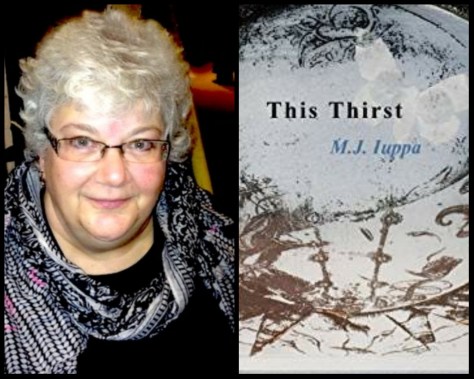
A~I have a web page and blog; and a presence on Facebook and LinkedInYou can also order Small Worlds Floating (Cherry Grove Collections, 2016)  and my new book, This Thirst (Kelsay Books, 2017) at Amazon.

Q~Is there anything else you’d like us to know?

A~Lastly, I think it takes a whole life to be a poet. I don’t think people “become” poets.  I think they “are” poets, and having a whole life gives them the means to perfect their craft.

The High Road / An interview with poet Allyson Whipple

The High Road

by Allyson Whipple

I. Highway
To know if you love
someone, drive
at least 500 miles with them.

Make the night owl get up early,
and the early bird wait.

I stare too hard at how
industry has cracked
open landscape.

We cross into New Mexico.

Oilfields,
fracking rigs,
behind us.

For 100 miles,
I sighed at dead
earth, sites
where trash outnumbered
cacti, where groundwater
was full of poison.

We cross from oil country
into no country.

II. Atmosphere
To know if you love
someone, spend
a week in close quarters.

West wind careens
against our tent at 35 miles
per hour. The sides buckle.

I am about to suffocate
in my shelter.

Wind brings the tent
to its knees.

The roof pulls down
toward our faces,
hair flying skyward
with static electricity.

The car our only refuge,
I watch sun
rise across a crack
in the windshield.

III. Cavern
An 800-foot descent
into the cavern.
In darkness, all my body
craves is sleep.

My knees have never known
such pressure.
My body thinks it is about to break.

I am deep in the heart
of New Mexico.
Some stalactites
still pulsing.
Some stalagmites
still reaching up
toward a ceiling
they will never penetrate.

An 800-foot ascent
out of the cavern.
My thighs burn
in cool cave air.

Upon emergence
I believe I am weightless.

IV. Bluff
On the night of no wind,
my body cannot adjust
to the cold, even with three
shirts, two pairs
of paints, gloves,
socks, hat, three cups
of coffee, two warm
bowls of beans.

The tent befriends
the air, welcomes
the chill in.

Things I took
for granted:
brushing my teeth;
toilets;
space heaters;
hot tea;
pillows.

My body believes
if I sleep, I die.

V. Water
When I am in the desert
all I think about is water.
Each drop I drink,
use to wash dishes,
my face, to brush my teeth.

On the night of rain,
we stay dry.

The tent stands
firm against the whims
of weather.

On the night of rain,
I sleep.

VI. Trail
We cross back into Texas.
Road signs only speak
of superficial distance.

At our best
we move two miles
an hour.
At our worst, half.

Two miles
into the Chihuahuan desert:
maples.

For a moment, I can believe
we are borderless.

I did not understand
how much dust
the desert contained.

Two more miles:
pine trees and firs
run up and down the mountain.

I did not understand
how quickly a landscape
could change on me.

VII. Peak
You warned me
about the weight of water.
I only half-listened.

Anyone who makes a metaphor
out of climbing a mountain
has never summited anything.

My body believes
if I stop,
I will never walk again.

There is no metaphor
for having to carry the remnants
of your own excrement
in order to leave no trace.

On top
of the mountain,
I am too tired
to sit.

We can look down,
see clouds beneath us.

I cry,
but I am not sure why
I need to.

To know if someone loves
you, cry
in front of them.

I am almost too tired
to stay awake
for the stars.
The Milky Way
a white ribbon
for my naked eyes.

For a moment, I believe
we are bodiless.

To know if you love
someone, climb
a mountain with them.

blue_house_photAllyson Whipple is a poet, amateur naturalist, and perpetual student living in Austin, Texas. She is the author of two chapbooks, most recently, Come Into the World Like That (Five Oaks Press, 2016). Allyson teaches business and technical communication at Austin Community College, and enjoys hiking and camping.

She describes herself as “an environmentalist and a feminist struggling with how to be political on the page. A confessional poet struggling with the ethics of turning real people into art. A poet in love with Texas, and angered every day by Texas politics.” She says she writes “from the intersection of deep love and deep conflict. A study of tension, always tension.”

Allyson and Bekah’s work has appeared together in TRIVIA: Voices of Feminism’s “Animal Instincts” Issue (2013) and When Women Waken’s “Knowing: Issue (2014). We wanted to know more about Allyson and her poetry, so here is our interview with her.

Q~Tell us a little about your poem, “The High Road.” Is there a backstory you want to share?

A~In the workshop I was enrolled in last spring, we were asked to write a poem that was a minimum of 6 pages long, without individual sections. I’d never attempted to write a poem that long before, but I was set to take a week-long camping and backpacking trip in the Guadalupe Mountains. I decided to draft the poem throughout the trip as a travelogue. On revision, I shortened things slightly and did add relevant sections, but the essence of the trip is still there.

Q~How is the poem representative of your work?

A~“The High Road” is a poem that deals with my two greatest obsessions: the terrain of Texas and the terrain of my heart. It’s a poem that focuses on something deeply personal, and the ways in which the personal is woven into the far west Texas landscape, the way in which I am constantly surrounded by something greater than myself. I always find myself returning to the idea of place and space. After both of my chapbooks, I thought I’d said all I needed to say about landscape and its effect on a person, but as I delved into my thesis, I found myself returning to those themes yet again. Geography is, for me, as large and mysterious as God, and the way I wrestle with place is akin to spiritual exploration.

Q~Did it come easily to you or was it hard to write?

A~The first draft was grueling, because up to that point I hadn’t written a poem longer than a page. I had to really stretch myself here. I was grateful to be able to revise and trim it down and shape it into a poem that felt more my own.

Q~What’s your writing process usually like?

A~My process is always changing. I find I need more mental/creative composting time than I used to. My poems require more research, because my works has become more concerned with the world beyond my limited vision and experience. These days I go through bursts of writing and revising, and then I spend several weeks doing anything but writing. Those fallow periods used to scare me. I used to think they were dry spells and worry if I’d ever write again. But I’ve come to realize they’re an essential part of my process now. I do have daily habits (yoga, meditation, walking). I feel I get stronger poems now that I’m not trying to push creativity every single day.

Q~Are you involved in your local poetry scene? What’s it like?

A~The Austin scene is amazing. The Austin Poetry Society hosts monthly meetings, talks, open mics, and critique groups. We’re home to some amazing slam organizations, including Austin Poetry Slam and NeoSoul. The Austin International Poetry Festival is a mainstay of our city. And of course, the University of Texas, Austin Community College, St. Edwards University, and Huston-Tillotson University all contribute through journals, readings, classes, and events. We have some of the best local bookstores around, including BookWoman, which is one of just a dozen feminist bookstores left in the country. And, we have open mic events in Austin or surrounding towns nearly every night of the week. My all-time favorite is I Scream Social, a showcase that features women-identified poets (and free ice cream!) every month. I’m there regularly and hate the months when I have to miss out.

Q~What are your poetry likes/dislikes?

A~I love poetry that plays with form, such as the abecedarian sonnets in Barbara Hamby’s All Night Lingo Tango. I simultaneously love the expansive poems of Rachel Zucker, and the compression of haiku. As for dislikes, I’ve never really enjoyed a poem in which the word “fart” appears.

Q~Who are you reading now?

A~Kaveh Akbar’s Calling a Wolf a Wolf, and it feels like every poet is reading this book right now, but also I think everyone should be reading this book right now, so that’s a good thing.

Q~What’s one piece of advice you want to share?

A~Your process is going to change. Your creative interests are going to change. Your projects are going to change wildly between when you get that first idea and when you actually finish them (or let them go). Sometimes that change can make us uncomfortable. However, it’s inevitable, and it’s worth learning to accept that all or most aspects of your writing are going to evolve over time.

Q~What are your poetry highs/lows of the last year?

A~My high has been finding a long-distance haiku partner. Each week, we send each other a new haiku by midnight in our respective time zones. No critique, no judgment, just sharing poetry. Not necessarily writing for publication, or worrying about whether the poem will go anywhere. Just writing and sending it. And, sometimes we miss our deadline, but we pick back up again. At the end of the year, my friend surprised me by telling me what his five favorites were. That’s the only feedback, and it was a delight to know which pieces had resonated with him the most. We’re all our own worst critic, so I loved knowing that two pieces I thought were inadequate actually were his favorites. This very simple writing practice brings me incredible joy.

Here’s one of my haiku partner’s favorite pieces of mine:

the breath from my sun
salutations in time
with your snoring

My poetry low, I hate to admit, has been my MFA program. Although I will graduate in the spring with a manuscript, my program has isolated me more than fostered community. I now understand why some people never write again or don’t write for many years, after completing an MFA. It has been difficult for me to speak about this, and I would never say that nobody should do an MFA program, but it was definitely a mistake for me.

Q~Is there anything else you’d like us to know?

A~In the spirit of not ending this interview on a low note… In addition to my thesis, I’m working on a long-term project in which I’m creating blackout poems of Ezra Pound’s Cantos. I post updates on Instagram, my blog, and my Medium account, so if you’re interested in those, check out my social media and enjoy!

Q~What drew you to Ezra Pound’s Cantos?

A~I was drawn to it for a few reasons: 1. Ezra Pound, for all he contributed to poetry, was a fascist. There’s apparently been a resurgence of blackout poetry since our current president took office. I think it’s a worthwhile endeavor to write over the words of politicians and artists with gross moral failings and make our own texts out of them. 2. The Cantos seems largely antithetical to Pound’s earlier poetics. Of course, poets and their creative interests change over time. But the Cantos are bloated, stuffed with allusions you need a degree in classics to understand, and the imagistic impulse Pound once prized is buried in a convoluted narrative. Once while on a hike, my boyfriend off-handedly suggested it might be fun to try to turn each canto into a haiku. I didn’t take his actual idea, but I am interested in finding the actual images in each poem.  3. Pound said “Make it new.” Well, Ezra, I’m taking your advice literally!

Q~Where else can readers go if they are interested in reading more of your work?

A~I’m participating in the 2018 Poet Bloggers Revival Tour, and you can find work there:  http://allysonmwhipple.com/. I also have recent work in the Summer/Fall issue of WORDPEACE. Finally, I have haiku forthcoming in Under the Basho.