Tag Archives: poetry

Every Election Cycle, The Wind From Birmingham To Chicago Smells Like Ashes / and interview with Khalypso The Poet

Every Election Cycle, The Wind From Birmingham To Chicago Smells Like Ashes

by Khalypso

saved! thank silent, merciful God we are saved!

a ghost rises from the parched soil
of a Chicago cemetery.

she drops a piece of paper into a box and suddenly
freedom rings for all brown things that are not
her tongue.

black women saved our asses this election cycle

her son is somehow
next to her & somehow
in Washington D.C. & somehow
at the bottom of the Tallahatchie River,
guiding its currents.

a well-intended hand grips her arm,
a pair of friendly lips kisses her mummified
cheek.

bless you
you have saved us

she is screaming into everyone’s faces.
she is calling for help.

thank you
for rescuing us from the cradle robber

she is pointing to a struck pine—
split down its trunk and weeping streams of
skittles, bullets, ink;

streams that sound like whistles
& roll across silt like jilted tremors.

we owe you so much

she snatches tires from rope, unable to bear
seeing anything swing.
she tosses sheets of steel to the earth.
she traps every match, every lighter in a meat
locker and tears the lights apart.

we should have listened to you

she is still screaming, still pointing

we owe you so much

we owe you so much

if we could go back in time and do this whole
election again, we would—

any black boy’s body has risen to the
surface of any river.
his mother falls, exhausted,
into an abandoned grave, the ivy molded to
accommodate the curve of her soaked cheeks.

if we could go back

there is jubilation in the streets.
every soft, brown thing is now named Mammy,
Messiah, or Most High.

we’d listen to you this time

she has stopped screaming.
she is whistling now—soft and serene.
she is cursing every selective, unyielding ear
& daring someone
anyone
to say something about the noise.

First published in Rigorous Magazine 2017.
poet

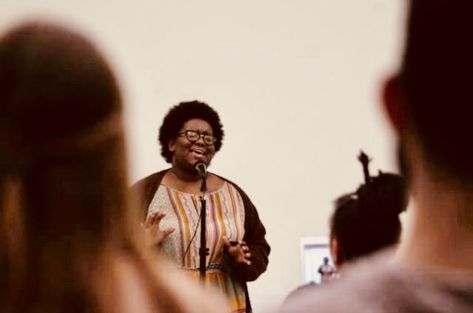
Khalypso is a Sacramento-based activist, actor, and poet. They are fat, black, neurodivergent, queer and badass. Their work can be found in Calamus Journal, Drunk in a Midnight Choir, Rigorous Journal, Wusgood Magazine, and Shade Journal, as well as a few others. They are a Leo-Virgo cusp, they want to be your friend, and you can find them on Twitter at KhalypsoThePoet. They are not here for your bullshit.

Of their style, Khalypso says, “I honestly do not know how to describe my style. I’d like to think I’m as vulnerable as Amy Winehouse. I’m honest with my poetry, much more so than in real life. The best thing I can do to describe my style is tell you that my favorite poets are Langston Hughes, Hanif Abdurraqib, Danez Smith, Ntozake Shange, Kaveh Akbar, Aziza Barnes, Julian David Randall, Luther Hughes, torrin a greathouse, George Abraham, Noor Najam, Logan February, Siaara Freeman, and Paige Lewis. I try to write like them, but I mostly just try to write like Amy Winehouse sings—beautifully.”

Bekah and Khalypso connected via social media. After reading “Every Election Cycle, The Wind From Birmingham To Chicago Smells Like Ashes,” we wanted to know more about them. So, here is our interview with Khalypso.

Q~What would you like to share about the backstory to this poem?

A~This poem came from seeing Twitter’s collective reaction to Roy Moore’s defeat and the fact that black women showed up against him the most. We stay doing that. We stay showing up when it’s time to protect the best interests of others. No one does that for us, and I’m fuckin tired. This poem is about the black woman’s mammification and black fatigue and a little bit about politics and a little bit about Emmett Till; how no one but his mama showed up for him. Black bodies are expendable until they’re useful, and, again, I’m tired.

Q~What do you hope to accomplish with this piece?

 A~I want to make people who subscribe to mammification and respectability politics feel really bad about it. I also want them to know they can fuck all the way off.

Q~Did the poem come easily to you or was it hard to write?

A~Emotionally, it was very hard to write. But, it came easy. I was, I AM, so angry.

Q~What’s your writing process usually like?

A~I smoke weed and then write whatever comes to mind. Obviously, I don’t only write when I’m high, but lately I’ve been doing that to see what I produce. I’m generally delighted with the results.

Q~What’s one piece of advice you want to share?

 A~With writing, I’d say to be vulnerable and honest at all times. Before craft, or precision, or readership, focus on that. I also, though, kind of feel like I’m too new to the game to offer sound advice, so take what I say with as many grains of salt as you want.

Q~Who are you reading now?

 A~Morgan Parker. Hieu MInh Nguyen. Saeed Jones. Luther Hughes.

Q~What are your poetry highs/lows of the last year?

 A~I got rejected by a ton of retreats and conferences, which made me feel like a motherless child. My highs were making it into BNV’s semifinals and being published by Glass and Drunk in a Midnight Choir—two dream publications.

Q~Is there any online resource you would like to recommend?

 A~Allpoetry.com is a nice, chill place to get feedback, but it’s mostly old white people on the site, which might turn some folx off.

Q~Where can readers go if they are interested in reading more of your work?

A~I have a ton of publications so I’ll include a few: Shade, Drunk in a Midnight ChoirGlass, Calamus, WusGood, Black Napkin, and yell/shout/scream. You can also connect with me on Facebook, Twitter, Instagram, and Tumblr.

 Q~Is there anything else you’d like us to know?

 A~I’m raising money to attend a couple retreats this summer. I do a lot of work in the spaces of activism and writing and most of it goes unpaid. If anyone is interested in helping me go to these retreats so I can improve my writing and hopefully put out a book, I ask that they consider donating to my Paypal, my Venmo: @khalcashbby, or my Square Cash: $khalcashbby. Every little bit of money helps in a big way, and everyone who donates will go in the acknowledgements page of my first full-length collection.
Bimbo, a Deer Story / an interview with poet Risa Denenberg

Bimbo, a Deer Story

by Risa Denenberg

For she had no body odor and lay motionless
beside the dead doe, and so
you took her home and fed her goat’s milk.

This you did: collared and tethered her, named her
Bimbo, a pet wandering a yard strewn with cars
on blocks and old oil tanks.

Your darling: adopted, broken, stroked, chosen.
And who am I, trussed and bound to a fault line,
who shadowed not her own mother, nor knows
how she is meant to be.

originally published in Menacing Hedge 2014.

risa (2)

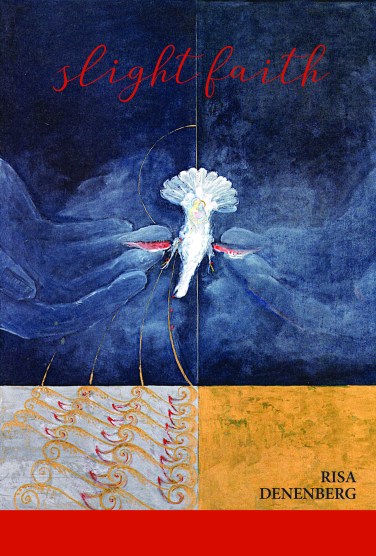
Risa Denenberg is a working nurse practitioner and poet with 6 published poetry collections. She is a co-founder and editor at Headmistress Press, a small independent publisher of poetry by lesbians. Her most recent collection is slight faith, just released from MoonPath Press.

Of her style, Risa says, “I write mostly free verse, a combination of lyrical and narrative, with attention to poetic devises such as assonance, alliteration, enjambment, repetition, lists, and anaphora. I have tried my hand at some forms such as sonnets, haiku, and villanelles. I often write poems using equal lined stanzas that hold a shape, but also abstractly-shaped poems with very different line lengths. I also write prose poems. I try to query the poem to see what shape it wants to be.”

Risa and Bekah connected via The 2018 Poet Bloggers Revival Tour. We wanted to know more about her and her writing, so here is our interview with her.

Q~Tell us a little about the poem, “Bimbo, a Deer Story.” Is there a back story you want to share?

A~It was originally published in Menacing Hedge and is included in slight faith.  It came to me after reading a news item that described an eccentric woman who had found a fawn beside her dead mother and took her into her home, treating her like a child. The details (feeding her goat’s milk, naming her Bimbo, etc.) are directly from the news story. It made me realize that any sentient creature, taken out of her natural environment, would probably never become who she was meant to be. I identified with that concept, not because I was adopted, but because I often wonder who I was meant to be. The poem hints at a troubled relationship between the narrator and her mother, but prefers to leave much to the reader’s imagination. I think the poem is similar to others of my poems in that it has a certain restraint, rather than being “in your face,” it shows (rather than describing) emotions, and hints of darkness without specificity.

Q~How is the poem representative of your new collection?

A~slight faith is a collection of poems that consider ways of creating and finding meaning, ways of seeing the world in all its horror and still wanting to live. The story that my poem, “Bimbo: a Deer Story,” is based on looks to the natural world (a dead doe, the fawn helpless at her corpse) and positions the fawn in an unnatural environment (a woman’s home). The story is simultaneously heartwarming and anomalous. In the poem, the narrator tries to understand who she is under the circumstances she has been dealt. She looks for meaning, which I believe has its core in faith. Many of us who are not drenched in religious life have difficulty talking about concepts like faith, and yet these tropes are found everywhere in art. I’ve learned “god language” through my work in end-of-life care, as a way of connecting with people who speak it. My own experience of faith vacillates between feeling authentic (faithful) and feeling hopeless (faithless). At core, faith says there is meaning. I lose and recover meaning all the time. slight faith is a way of finding peace in that dilemma.

Q~You mentioned your work in end-of-life care, how much does your “day job” influence your writing?

A~There is no doubt that my years as a nurse, witnessing illness, suffering and death, has been a bedrock of my need to write. It has also given me experiences to write about, as I have done in my chapbooks What We Owe Each Other and In My Exam Room (both published by The Lives You Touch Publications). When life seems suffused with sadness, despair and even alienation, poetry carves out a place for these difficult emotions in the world.

Q~How do you balance your work at Headmistress Press with focusing on your own writing?

A~It can be difficult. I not only spend many hours a week running Headmistress Press with Mary Meriam, I also work full time and volunteer with End of Life Washington, the advocacy group for Washington State’s Death With Dignity Law. Being an introvert and living alone helps me to carve out time for writing. I try to write first thing in the morning before other things clamor for my attention. I also go on retreats two or three times a year where I focus exclusively on a writing project.

Q~What’s your writing process usually like?

A~I write in spurts, sometimes daily, but sometimes not at all for weeks. I typically start with jumbled thoughts/emotions, unformatted, like journaling. I usually let it sit, but if there is a spark of truth there, later I might interrogate the writing by asking: what is it I am trying to say here? My goal in shaping and revising a poem is to strip away any words or codicils that feel false or so private that they are unlikely to speak in any viable way to a reader, and then to locate specificity of language by inviting the lines and stanzas to dialog. I read the work out loud to see if it has rhythm or musicality. Typically, writing poems is my attempt at meaningful conversations with myself, that I deeply hope will communicate meaningfully to someone out there.

Q~What’s one piece of advice you want to share?

 A~Just write the poems. Let the rest take care of itself. Support other poets; buy their books; attend readings and poetry events. Read as much poetry as you can, and learn how to read your own poems aloud.

Q~When you say, “learn how to read your own poems aloud,” do you mean as part of the writing process or were you talking about poetry readings?

 A~Poetry is about the sounds of words. When I’m reading others’ poems, if a poem excites me, I will often stand up and read it aloud. When I’m writing, I stop and read a stanza or a line aloud many times as I am revising and working on the poem. I don’t enjoy it until it “sounds” right. What I was referring to as advice, however, is that any poet who has the opportunity to read their work for others should, first of all, do it (!), and second, rehearse reading the poems aloud many times. A reading opportunity usually comes with some sort of time limitation, so it’s also very important to time the reading. Misusing the gift of time is very poor manners. Finally, with practice and deep familiarity with the words, I think most poets could give a convincing, strong reading. Personally, although I’m an introvert, I totally love reading my work for an audience.

Q~Who was your poetry first love?

A~When I was nine, I had pneumonia and had to stay home alone for several weeks, since my parents both worked. I had Robert Louis Stevenson’s A Child’s Garden of Verse with me in bed, and it was a wonderful comfort to read poems about children that felt like they could have been about me (when I was sick and lay abed, I had two pillows at my head). I also have to credit reading the Hebrew Psalms and connecting with their deep sorrow, lamentation, and longing. In high school, I fell in love with Emily Dickinson, started reading the beat poets, and was introduced to Sylvia Plath and the confessional poets. I greatly expanded my reading list after high school, but these introductory poets were very formative in my love of poetry.

Q~Who are you reading now?

A~I have been gob smacked by so many contemporary poets, and in particular, LGBTQ poets. I have bought so many books of poetry in the past year that I fear I’ll never find time to read them all. Lesbian feminists held sway with me in previous decades (Rich, Lorde, Jordan, Cheryl Clarke, Marilyn Hacker, Pat Parker, so many others), but lately the gay boys have really knocked me off my feet. I only have room here to name a few: Mark Doty; Danez Smith, Philip B Williams, Jericho Brown, Richard Silken, Saeed Jones, Carl Philips, Spencer Reece; Ocean Vuong. I must say that I also adore Natalie Diaz, Sharon Olds, Ilya Kaminsky, and Greg Pardlo.

Q~Where can readers go if they are interested in reading more of your work?

A~My books are available on Amazon or at my website. I also have a blog, and you connect with me on Facebook, Twitter and Instagram.

slightfiath-frontcov-withbleed

Love Can Be a Chokecherry / An interview with poet Juliet Cook

Love Can Be a Chokecherry

by Juliet Cook

It starts with a multi-colored glitter dress lifted up high
to show thighs wrapped with garter belts made out of garter snakes.

She knows they’re not poisonous, but
she finds out they’re not really big enough
for her own magnetized thighs, unless she sits still
in one place forever. It’s a cold place, especially at night.

She knows another nightmare is coming
when the bird sounds turn into dark moans.
Mounds of wings torn, ripped, pitched
until she wonders when did wings even exist?

None of this is real, so why give birth to more?
Somebody will sea the shells, but not the birds
tiny fetuses stuck on concrete, dripping beaks,
ants crawling in and out of the cracked necks.

Now they deserve to be hung from a tree
like rotten chokecherries.  Like broken ornaments
that will fall down hard, finally trash themselves
into oblivion, then be flung into the cesspool.

It starts with a kiss that turns into a rotten apple chokehold.
Being smothered into nothing. A bitten into, spit out core.

First published in diode 2014. Also appeared in Cook’s chapbook, Red Demolition (Shirt Pocket Press, 2014).

IMG_5505 (2)

Juliet Cook’s poetry has appeared in many literary magazines, including DIAGRAM, diode, FLAPPERHOUSE, and Menacing Hedge. She is the author of numerous poetry chapbooks, an individual full-length poetry book, a collaborative full-length poetry book, and has another individual full-length poetry book forthcoming. She sometimes creates semi-abstract painting collage art hybrids.

She describes her style as, “emotional hailstorms (based on and derived from thoughts/feelings/memories) that are redirected and reshaped into poetry, sometimes more direct and other times more abstract. Often on the dark side.”

Juliet was one of the first poets with whom Bekah connected online via Twitter, and they both share an affinity for the number 13 (Bekah is honored to be counted among Juliet’s Thirteen Myna Birds flock). Juliet is a very interesting person who writes striking poetry, so, of course, we wanted to include her in this interview series. Here is our interview with her.

Q~Tell us a little about the poem we’re including with your interview. Why did you choose it?

A~It was a bit difficult to choose one particular poem, since I’ve been writing poetry for more than twenty years, and it has explored various different directions, but the poem I chose is “Love Can Be a Chokecherry.”

I don’t remember exactly when I wrote it; maybe close to 5 years ago?

For well over 5 years (probably closer to 7), a lot of my poetry was focused on loss, mental turmoil and sadness, and brokenness, including broken (borderline abusive) relationships, and no longer believing in or trusting in love – and I think this poem represents all of those things. Body parts, insects, and dead birds have made their way into quite a few of my poems too.

So, have dolls and holes and blood.

Q~Why do you write poetry?

A~For  many years, poetry has felt like my brain’s preferred form of creative expression. When I was a kid, it felt creatively fun, even if other people thought it was nerdy. When I was a teen, it felt like a melodramatic, over-the-top angst fest, expressing itself from a shy and quiet girl’s brain, because I wasn’t shy and quiet on the inside.  As an adult, it has undergone various incarnations and creative phases, all of them individualistically expressive. Word choice, word usage, emotional expression, dream interpretation, and sharing parts of my own thoughts/feelings my own way.

Sharing parts of myself and allowing them to continue to exist even after they’ve begun to meld with other parts.

When I was younger, the process of writing a poem sometimes helped me figure out and interpret my true feelings.  That still happens occasionally, but in more recent years, it feels more like poetry is my preferred form of expressing myself in sudden onslaughts or crafted journal-like entities or repetitive coagulations instead of keeping it hidden inside.

For the most part, my poetry/art is a small scale personal interpretation – and even though I like a variety of different styles of poetry, small scale personal is my overall preference.

Q~What are your poetry likes/dislikes?

A~I like the poetry itself.  The writing, the revising, the reading, the submitting, the independent non-corporate publishing, the sharing, the interpretation, the connecting to others through the poetry.  Poetry as expression, poetry as art, poetry as emotion, poetry as questioning, poetry as exploring.

I dislike aspects of the poetry scene that feel too close for comfort to some sort of popularity contest involving group attacks or judgment calls. Poetry can be political in many different, powerful ways, but I don’t like the forming of groups outside of the poetry that take a side and lump other sides together and judge them and try to send other poets to jail.

I’m a small scale individual poet, not a large scale judge.

Q~What are your poetry highs/lows of the last year?

A~A low point of the last few years involves me getting very excited about having poetry accepted, but then it never ends up being published. This has happened so much more than usual in the last few years that I’m worried it’s slightly toned down my excitement about poetry acceptance and my trust that poetry presses are fairly well organized and caring. Especially in regards to poetry chapbooks, I’ve had one solicited, accepted, then ignored and never published – and I had another chapbook manuscript accepted by a press that suddenly folded and then accepted by another press that suddenly folded.

In the middle ground are my concerns that my poetry of the last few years seems to have mostly remained in a similar plateau, and I wonder of that is too close to stagnation. I can help myself feel better about recurring repetitive content by thinking about the art of Louise Bourgeois, which I love.

A high point is writing more poetry, reading more poetry, and having more poetry chosen for publication. In addition to inside various literary magazines, one of the poetry chapbooks from the low point up there was recently accepted by another small press – so Another Set of Ripped Out Bloody Pig Tails is forthcoming from The Poet’s Haven. Also, my second individual full-length poetry book, Malformed Confetti, is forthcoming from Crisis Chronicles Press.

 Q~What’s one piece of advice you want to share?

A~Be yourself but don’t be completely full of yourself.  Read other’s poetry, too, consider other writers’ points of view, reconsider some of your own thoughts and feelings, realize that you’re allowed to change your mind and your style, and that your poetic voice and choices and decisions and goals and aims should ultimately be your own, regardless of whether you do or don’t fit in anywhere in particular.

It can be positive to be connected with other poets, as long as you still have a focus on the real and true you – and try your best to allow yourself enough time and space to create your own poetry.

Q~Where can readers go if they are interested in reading more of your work?

A~I try to link to my most recently published poems (as well as other details related to me and my writing) via my Horrific Confection website. The online sources I use most are my personal Facebook page, My Blood Pudding Press Facebook page, my personal blog, my Blood Pudding Press blog, and Twitter.

Sin É / An interview with poet Jayne Stanton

Sin É

by Jayne Stanton

We steam on barstools
read between slogans on a plastered ceiling
tune to the cuts and grace notes in banter
binge on ambience, high on E minor.

Coburg Street, past midnight, soaks
in sodium light.  Rain beats time
on bodhran umbrellas, my spine
a river of running quavers that stick
to the soles of my sensible shoes
so I high-step the home stretch.

Framed in doorways on Wellington Road
crinoline ghosts wear mirrored skirts
that flirt with moonlight.
Guest house stairs are in rising fifths.
My top floor room’s a tall ship, exploring
the lilt in the Lee’s liquid fingers.

First appeared in Southword 2013. (Highly Commended in the 2013 Gregory O’Donoghue International Poetry Competition.)

Jayne Stanton

Jayne Stanton lives in Leicestershire, UK.  Her poems have appeared in various print and online magazines and anthologies including Best British & Irish Poets 2017 (Eyewear Publishing).  She has written commissions for a county museum, University of Leicester’s Centre for New Writing and a city residency.  A pamphlet, Beyond the Tune, is published by Soundswrite Press (2014).

“Lyrical free verse best describes my style,” Jayne says. “ I’m also a musician, so I’m continually striving for musicality in my writing.  It’s what I instinctively tune into at poetry readings; my default, when reading silently, is to sub-vocalise.  I tend to favour brevity over narrative; my work often has a dark under-layer.”

Jayne and Bekah connected via The 2018 Poet Bloggers Revival Tour. We wanted to know more about her and her writing, so here is our interview with her.

Q~Tell us a little aboutSin É.”  Is there a back story you want to share?

A~The inspiration for the poem was a traditional music session in a bar in Cork, Ireland (I was on a poetry exchange as part of O’Bheal’s Twin Cities project, at the time).  As a fiddle player in a ceilidh band I’m more accustomed to performing than being on the receiving end, so the experience was a change to my usual perspective.

Q~Did it come easily to you or was it hard to write?

 A~The first draft of this poem was written around five months later.  I think the time lapse was beneficial in that it allowed the experience to percolate until the rain, the city streets, and my accommodation overlooking the river also took on a musicality of their own.  There were fewer re-drafts than usual so, although the poem didn’t write itself, it wasn’t an arduous process. The poem was Highly Commended in the Gregory O’Donoghue International Poetry Competition, 2013, and published online in Southword issue 23A.  The poem, together with the judge’s comment and my report on O’Bheal’s Twin Cities project can be found here.

Q~What’s one piece of advice you want to share on writing?

A~Writing is a solitary act, but it’s equally important to actively seek, and maintain, an outward focus in order to inspire and inform one’s writing.  Connect with other writers, both face-to-face and online (it’s never been easier); be an active participant in your local writing scene; attend writing workshops, poetry readings, literary events, festivals; support the work of others (it’s not a one-way street); live life (it’s the richest writing material I know).  And, read far more poetry than you can ever write.

Q~You mentioned on your blog having signed up for some writing workshops recently.  Why do you value this?

A~I look on writing workshops as part of my ongoing poetry education.  I value the learning to be gained from more experienced poets in order to explore, for example, the use of writing constraints, set forms and routes into writing that I tend to shy away from, ordinarily.  Writing outside of one’s comfort zone often produces surprising results.  For me, it’s the main benefit of joining a NaPoWriMo group, too; I’m prompted into writing what I’d never otherwise have written, in terms of subject, form, choice of language etc.  April becomes a break-out from my writing rut.

Q~Are you involved with your local poetry scene?  What’s it like?

A~There’s a lot happening on the poetry front in my local area.  Many local writing communities overlap and there are a growing number of regular open mic poetry and spoken word events, so there’s something for everyone, whatever their style or preference.  Leicester’s two universities also organise literary and independent small press events. I’m involved in running  a women’s poetry group, Soundswrite, which meets twice monthly to read and discuss published poetry by others and to workshop each others’ poem drafts.  I also attend the South Leicestershire Stanza, which is affiliated to The Poetry Society.  And I regularly read at poetry open mics across the UK Midlands as I think it’s healthy to step outside of one’s poetry locality.

Q~How does having a women’s only space like Soundswrite enable creativity for you and the group?

A~Soundswrite was set up in 2005, by Karin Coller and Pat Corina, as an open group for women in the UK East Midlands enthusiastic about all aspects of poetry.  In my experience there exists a difference in group dynamics between the women-only and mixed gender poetry groups I attend.  I think it’s fair to say that, while most of the active members of Soundswrite also attend other (mixed) groups, Soundswrite’s longevity is due, in part, to the need for a women-only space within the wider poetry community.  I continue to value our robust discuss of all forms of poetry, and insightful and impartial feedback on work-in-progress.  Soundswrite Press provides a showcase for our writing, having published, to date, several anthologies, and single-author pamphlets and short collections of poetry.

Q~Do you find yourself returning to themes or subjects in your work?  What are they and why do they resonate with you?

A~Many of my poems are slants on memories (or misrememberings), grains of truth or pure fiction.  In writing about the people who made me, I explore love in its various forms and guises, including the darker side; ageing and longevity are offshoots from the theme.  I’ve recently begun to explore superstition, old wives’ tales and folklore for a new writing project.

Q~Which poet first made you fall in love with poetry?

A~After years of studying the Classics and the English Romantic poets, it was Wilfred Owen’s WW1 poetry that leapt off the page and introduced me to a very different world: shocking images and vivid detail wrought from first-hand experience; poetry as protest and honest reportage.

Q~Who are you reading now?

A~I’ve been reading Ocean Vuong’s Night Sky with Exit Wounds; it was an honour to hear his T S Eliot prize reading in London in January.  Helen Dunmore’s final (and Costa prize-winning) collection, Inside the Wave also had a profound effect on me, especially its end-of-life poems.  Next on my TBR pile is Wislawa Szymborska’s Here, translated from the Polish by Clare Kavanagh and Stanislaw Baranczak.

Q~There are lots of publications out there.  What is a literary gem you feel deserves more attention?  Why will we love them?

A~I consider Magma Poetry to be one of the best windows on the breadth of contemporary poetry; it publishes work by new or little-known writers to the more established, accepting international submissions.  With reviews of current publications and thought-provoking articles, it is as informative as it is inspirational.  With three themed issues annually and a rolling editorship, Magma maintains a fresh approach to the publishing of poetry and comment.

Q~Where can readers go if they are interested in reading more of your work?

A~More of my work can be found in London Grip New Poetry, Ink, Sweat & TearsAntiphon, and The Lampeter ReviewYou can also check out my blog and follow me on Twitter.


Sirenia / An interview with poet Emily Holland

Sirenia

by Emily Holland

I fucked a girl with a mermaid
tattooed on her back and felt
something like an ocean move
under me, a falling tide just out

of reach. I melted an ice cube
down her stomach, said here,
I know you’re out of water, said
here, I know you miss the sea.

first appeared in Impossible Archetype 2018.

Processed with VSCO with s5 preset

Emily Holland is 23 years old and a recent graduate of the George Washington University, where she received a BA in Creative Writing and English. She lives in Washington, D.C. with her girlfriend and her cat and is currently a manager at a coffee shop. She plans on beginning graduate school in the fall of 2019.

Emily describes her style as contemporary. She says,  “Lately, I’ve drawn inspiration from Loiuse Glück, Danez Smith, Meg Day, Aracelis Girmay, Terrance Hayes, Kay Ryan, and Richard Siken. I think we can see each of them as contemporary in their own way— some using their poems to draw attention to our most painful current events, others writing about identity in its many forms. My hope is that my writing also falls into a similar category. I don’t tend to follow traditional forms, and if I am writing in form, I always try to subvert it in some way. It feels almost like our job now to do anything we can to acknowledge the poetry of the past while transforming it into something very present.”

Bekah and Emily’s work—including the poem above—both recently appeared in Issue 3 of Impossible Archetype, a Dublin-based journal of LGBTQ+ poetry. We wanted to know more about Emily and her writing, so here is our interview with her.

Q~Tell us a little about your poem, “Sirenia.” Is there a backstory you want to share?

A~This poem originally appeared in my undergraduate thesis. At the time, I was newly “out” as a queer woman, and I was struggling to grapple with that newfound liberation/identity in my writing. This poem does have some truthfulness to it, in terms of subject matter—though I’ve always defined “truthfulness” in my writing as more of an honesty in theme rather than events. We all embellish and create for our poems, but without some essence of poetic truth behind those literary devices, the poem would read hollow. For now, I’ll leave the so-called truthfulness up for my readers’ interpretation.

Q~What themes or subjects do you find yourself returning to in your work?

A~I tend to write a lot of poems about queerness and the South, having grown up in North Carolina. I find that the two are so often in conflict with each other and that juxtaposition works well in poetic form. I dwell a lot on childhood, not necessarily my specific childhood, but I do draw from certain instances and then expand or elaborate to fit the poem’s needs. When thinking of poetry, it’s always been connected to identity—my personal identity can’t help but permeate everything I write, even if my writing isn’t outwardly “queer.”

Q~What’s your writing process like?

A~Sometimes, I just have a line or a few words pop into my head—I’ll add them to a Google doc of lines that will hopefully end up in a poem someday but maybe don’t fit anywhere yet. Other times, I have a concept/theme/idea in mind, something like a new interpretation of the pantoum (which I’m working on) or maybe just an image like catching fireflies in summer. Those poems tend to take form more quickly, but the workshop process is still quite long for me. I’m always hesitant to call something “finished.”

Q~What draws you to poetry?

A~I had always written poetry as a kid, albeit not very good poetry. Having a poem accepted to a small publication was encouraging in my last year of high school. Where it really resonated with me was my first year of college—I had signed up for a poetry class on a whim, though I always knew that I wanted to study English. My professor was Jane Shore, who would later become one of my closest mentors throughout my writing career. Her insight changed the way I looked at poems. We were studying Lowell’s “Imitations” and learning to craft our own poems by borrowing certain aspects of already published works (such as style, imagery, or tone). And, while many of my classmates were merely using the class as an elective course, I was fully invested. And, I’ve been fully invested ever since.

Q~Who was your poetry first love?

A~ee cummings was the first poet whose work I committed to memory—I suppose his poetry “looks” the most like poetry (or what I thought poetry should look like) on the page, with its crazy line breaks and spacing. There’s something about the sparseness in his poems that really resonated with me, the way he seems to say more in what he’s leaving off the page than what he includes on it. I still remember each line of my favorite poem of his, a short one starting “no time ago” and ending with two simple, devastating lines: “made of nothing / except loneliness.”

Q~What do you feel is the poet’s role in society?

A~As poets, we are recorders of our time. Poetry gives us the ability to transform what we see or experience into something with a greater meaning, a universality. The history of poetry is one deeply ingrained in the social customs of our world. Spoken word poetry, which I admit is not my forte, is taking on social justice issues and greater social awareness as its larger project. Printed poetry can sometimes occupy a similar space, but it seems more timeless, more lasting, in a sense. Not all poetry on the page goes viral, but it does stand the test of time—our role as poets is to determine which space we want to occupy and what our larger project should be or will become.

Q~What’s one piece of advice you want to share?

A~Write, always. If you can’t write, read read read! Sometimes the inspiration just isn’t there for me, bur reading always helps me get back into the poetry state of mind.

Q~Who are you reading now?

 A~I’m working through Saeed Jones’s “Prelude to Bruise” and Sharon Olds’ s“The Dead and the Living” right now. I’m also almost finished with Louise Glück’s “Proofs and Theories,” which isn’t necessarily poetry, but appeals to my interest in literary theory.

Q~Where can readers go if they are interested in reading more of your work?

A~Send me a message on Instagram if you want to workshop! I’m always looking for new sets of eyes, and Google docs make it so easy to workshop new poems with other writers. Also, if you’re in the D.C./DMV area, I’m trying to get a queer poetry night started to provide a safe space for poets to come read their work, so be on the lookout for that.

Half-Life / The W.I.S.H. Press interview with Bekah Steimel

Half-Life

by Bekah Steimel

I’ve had my fill of emptiness
and I’m starving for hunger
for an appetite of anything-but-this
this chemical buffet
all-you-can-eat elevation
that leaves me low and unsatisfied
My joy comes in doses
My joy has a half-life
As do I.

First appeared in W.I.S.H. Press 2016

In July 2016, Walking is Still Honest Press published this interview with Bekah to accompany her poem, “Half-Life.” The press has since closed.

Q~Can you tell us a little bit about yourself? At what age did you start writing? Have you always written poetry? Who/what first inspired you to start writing? Who are your favorite poets?

A~I’m 36 and last year I eloped in Las Vegas (thank you Supreme Court!!). I’m a poet and lover of all things animal, artistic and pharmaceutical. I’ve attempted poetry most of my life, and started sending out submissions five years ago. My Gramma always encouraged any creative endeavor. In her last letter before her death, she told me to keep writing poems. That’s all it took. My favorite poets are Adrienne Rich and Jim Morrison, for very different reasons.

Q~How do you first start writing a poem? Does it come to you out of the blue, or do you have a set time where you meet with your Muse each day and let the words just … come? Has your idea of what poetry is changed since you began writing poetry?

A~My poems just kind of reveal themselves to me. When they are ready to rise, so am I. I can go for a month or two without writing. Poetic camel, I guess. My idea of poetry is constantly evolving, which definitely keeps me motivated to change with it.

Q~Are you on Facebook or Twitter or any other social media? Does that fit into your writing life, and if so, how? 

A~I am on Facebook, Twitter and Instagram. The first thing I like about connecting with other poets is the ‘rejection camaraderie’ we share. I see that rock star poets I admire and respect get the same form emails and ‘best wishes’ I get, too. Secondly, it’s a good place to find submission opportunities.

Q~What words of encouragement can you offer other poets who are trying to get their work noticed?

A~My advice to any struggling poet is just to remember we are all struggling poets. That’s it.

At the Landing / an interview with poet Jessica Goodfellow

At the Landing

by Jessica Goodfellow

atthelanding

First published by FIVE:2:ONE Magazine 2018.

Janne1small

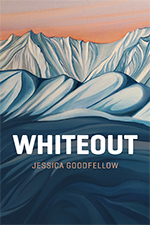
Jessica Goodfellow’s books are Whiteout, Mendeleev’s Mandala, and The Insomniac’s Weather Report. She was a writer-in-residence at Denali National Park and Preserve. Her work has appeared in Threepenny Review, Beloit Poetry Journal, The Awl, The Southern Review, Motionpoems, and Best New Poets, and is forthcoming in Best American Poetry 2018.

Jessica says of her style, “My educational background is in analytical fields, and I think that shows in my poems—they tend toward the abstract, festooned with logic games and scientific and mathematical vocabulary. I’d like very much to write something with less of an obvious anchor, with more trust in the unconscious tether to the conscious mind. I try to do that—I think it’s important to try to write outside of your comfort zone—but so far, I haven’t succeeded.”

Bekah and Jessica’s work—including the visual poem above—both recently appeared in #thesideshow at FIVE:2:ONE Magazine. We wanted to know more about Jessica and her poetry, so here is our interview with her.

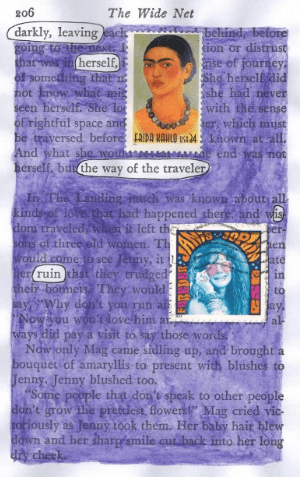
Q~ Tell us a little about “At the Landing.” What was the source material for this piece? What made you choose the stamps?

A~I call each erasure by the title of the short story it came from. I chose Eudora Welty’s short story collection, The Wide Net (Harcourt Brace, 1971), as my source material from the many books on my bookshelf because it has such an evocative vocabulary and also because there was a lot of space between the lines, making it easy to work with on a practical level. I have a box full of international stamps that I’ve been saving for some future project yet unconceived, and one of the erasures I worked on reminded me of a stamp I knew I had. After that I just tried putting them on different erasures, looking for stamps that were thematically relevant. I thought it was pretty unique, but I’ve since seen that Mary Ruefle has used this technique before.

Q~What appeals to you about erasure/visual poetry?

A~This is my first foray into erasure poetry. At the time I erased this piece, my mother-in-law was staying with us for end-of-life care, and I found that though I had vast swaths of free time while she slept, the need to be on-call at all times meant I couldn’t get into the writing space in my head. So, I decided to try erasure instead, and that worked really well for me, possibly because the act of erasing mimicked the experience I was having as I watched my mother-in-law dying, disappearing slowly.

Q~So sorry for your loss. Your new book, Whiteout, is also about loss. I am fascinated to hear more about the book and your experience as writer-in-residence at Denali National Park and Preserve. How did that come about?

A~My most recent book is about my uncle who was a mountain climber. He died on Denali in what was, at the time, the worst mountain-climbing accident in US history. I applied to be a writer-in-resident in the park in order to finish that book. I stayed in a one-room cabin out by the Toklat River, with only my sister. We were in the park (Denali National Park and Preserve) for 10 days. Being there gave me an understanding of why my uncle was compelled to do such a dangerous thing as climb Denali. Wandering around the vast park, feeling completely alone in the wild, going places we knew he had been, was profoundly moving. We were there 49 years and one week after he was lost—watching the sun wheel around the sky instead of set in the evening, I knew he had seen that, too. For the park I wrote a series of poems as an artistic donation. They say better than I am doing now what my experience was. Here is one:

The Wandered

My sister’s drawn to clean-edged kettle ponds,
learning how to tell which pools were formed in basins
left behind by glaciers, and which weren’t.

I’m captivated by erratics, empty-house-sized
boulders stranded in a strange land by ice
that melted out from underneath them.

Erratic comes from the Latin errare,
meaning to wander, to stray, to err. We are
not wrong, my sister and I, to feel kindred—

kin and dread—with what remains after
a mammoth force, no longer visible,
has carved out such a tattered landscape.

You can read the others here: https://www.nps.gov/dena/getinvolved/air-goodfellow.htm  Only “Nine Views of Denali” is in my book, because I wanted the park to have some original work not from the book. “The Wandered” is the one I most regret not putting in the book. Kettle ponds are formed by retreating glaciers carving out grooves in the landscape, and leaving meltwater. Erratics are giant boulders that were carried along by glaciers and deposited in a location where they seem out of place–they don’t match the surroundings because they didn’t come from there–many of them may have come from a mountain. Denali National Park and Preserve is dotted with both kettle ponds and glaciers.

Q~ Is there any online resource you would recommend for anyone thinking about a project book, like Whiteout?

A~The Cloudy House is a website of interviews with poets who’ve written project books, curated by poets Cynthia Marie Hoffman and Nick Lantz. If you are interested in project books, or want to know what one is; if you are curious about how having a project affects the writing process and later the marketing; if you wonder what kind of topics end up as project books, and whether a poet starts out with a project in mind or notices one is arising later—topics such as these—the interviews here are useful and fun to read.

Q~Your poetry has received a lot of acclaim. What’s one piece of advice you want to share? 

A~Your poetry should surprise you, but it won’t much of the time. That’s okay. Just keep sitting with it until it does. It takes a long, long time to write the words that are the right words. A short poem can take months. Don’t give up, and don’t get impatient and publish something before it is truly surprising to you. Read everything aloud—the part that you want to rush through is the part that you need to keep working on. 

Q~There are lots of publications out there. What is a literary gem you feel deserves more attention? Why will we love them?

 A~Forklift, Ohio: A Journal of Poetry, Cooking, & Light Industrial Safety is a quirky journal featuring smart, unusual poetry. Even the format of the journal is quirky (see their website for examples http://www.forkliftohio.com/ ), and with a print copy comes random pieces of ephemera, such as an envelope of seeds for planting or an old key fob from a hotel. Fresh writing, a little bit askew—there is nothing like it. This journal knows what it likes and doesn’t apologize for its slightly off-kilter aesthetic. From their guidelines (known as their logistics page) come these two pieces of info (plucked from among many others): 1) “[we] Fetishize the aesthetics of early industrialized society in a distinctly post-industrial fashion;” and 2) “[we] Include, besides poetry, such diversions as recipes, agricultural wisdom, home economics lessons, and other bits of nonsense.” How are you not going to love this journal? 

Q~Who are you reading now?

A~Right now, I’m rereading Natasha Sajé’s Vivarium. I love this book—it’s the right amount of cerebral for me. The poems are built around the alphabet and as with all good constraints, the alphabet fetishization inspires a certain meandering that is unexpected and mesmerizing. I’m also reading Viet Thanh Nguyen’s dark and disturbing novel, The Sympathizer, for my book club.

Q~Are you involved in your local poetry scene?

A~I live in Kobe, Japan, and there isn’t much of a poetry scene in English here (I don’t write poetry in Japanese). A couple of times a year there is a reading series event, but it’s any kind of writing in English, and more often than not it isn’t poetry. But, I attend and have been invited to read several times. I also belong to a group of poets around Japan writing in English who do a linked poem project. We each write a single stanza with given parameters and constraints, and pass it to the next poet who uses our stanza for inspiration, and that’s a lot of fun. It tends to be seasonal, in the Japanese tradition. There’s also the annual Japan Writers Conference that I attend about half the time. Mostly though, I’m on my own as a poet here.

Q~How has living abroad changed you as a writer?

A~I get asked this question often, and I have to say that I don’t particularly write about Japanese themes. Local imagery and the occasional Japanese word or phrase will show up in my poems, but I don’t specifically seek to dwell in the experience of living here—I leave that to other writers, while I tend to be interior in my work, and so only the part of Japan that penetrates my interior identity appears in my work. However, living here means a certain amount of isolation—from the poetry scene back home, from native speakers who comprehend my words without effort, from society at large here in this place where my foreignness is the most important aspect of me to nearly everyone I interact with—and that gives me more time and space to write than I imagine I would otherwise have. Also, my sense of being an outsider is heightened and continual, which I think is good for any kind of art even while it may not always be good for the private life of the individual artist.

Q~Where can readers go if they are interested in reading more of your work? 

A~I’ve linked to most of my online publications on my website. My erasures aren’t listed there, but here are journals where you can see more erasures: Star 82 Review, Thrush Poetry, Calamus, and decomP. On Facebook, I’m Jessica Goodfellow Ueno, and my Twitter handle is @jessdragonfly.

Whiteout Front Cover


origin story / An interview with poet Caseyrenée Lopez

origin story

by Caseyrenée Lopez

once upon a time
i wanted to die

be reborn a god

i stopped short,
killed myself

watched as i
became a christ

became my own
salvation

First published in the new gods (Bottlecap Press, 2018).

pic

Originally from Georgia, Caseyrenée Lopez relocated with their family to Virginia in the summer of 2017. They work as a professor of English at John Tyler Community College and have two full-length collections of poetry, the new gods (Bottlecap Press) and i was born dead (About Editions), as well as a chapbook, heretic bastard (Clare Songbirds Publishing House) forthcoming in 2018. In addition to teaching and writing, Caseyrenée also edits Crab Fat Magazine and publishes poetry and experimental work by queer and trans people at Damaged Goods Press.

Caseyrenée says their style of writing is “similar to Anne Sexton, Sylvia Plath, and other contemporary feminist writers.” They say, “One time I was compared to William Faulkner, and I still don’t know how I feel about that. I know my work is largely confessional in nature, but isn’t all writing confessional in some sense?”

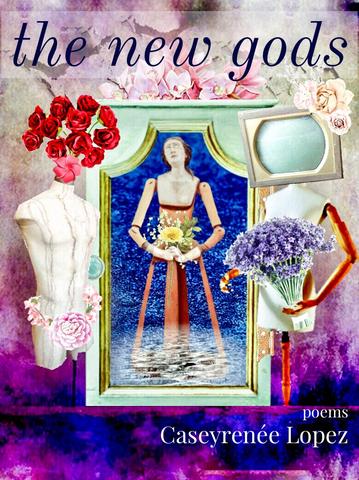
Bekah and Caseyrenée first connected online when their work appeared together in the Yellow Chair Review 2015 Anthology. With Caseyrenée’s full-length collection, the new gods, being released this week, we thought this was a great time for an interview. So, here is our interview with them.

Q~How is “origin story” representative of your new collection?

A~“origin story” seems to me, the best representation, thematically, of the new gods. It provides a summary of the collection by illustrating the repetition of death, rebirth, shedding skin, or morphing into a new form or self and observing the changes—there is a lot of “watching” in this collection, and “origin story” also provides the eyes through which readers will encounter many of the poems.

Q~Do you find yourself returning often to these themes in your work?

A~I sometimes feel that I am writing the same poem over and over again. I write about queerness, orientation, non-binary gender, infertility, and trans love because these are the things that I know and experience. I’ve never written a persona poem because the thought of trying to inhabit someone outside of myself on such an intimate level turns me off—why would I write about things I haven’t experienced when there are so many people who have the lived experience to write about it? Imagery-wise, I find myself using birds, teeth, bones, and flora in my work repeatedly. I used to have dreams all the time where my teeth would crumble and fall out of my mouth, and it really freaked me out, or that I would break my arm or leg, and those images gave me a lot to work with, emotionally.

Q~Did the poem, “origin story,” come easily to you or was it hard to write?

A~Just as with 95% of this collection, this poem came every easy—in that it flowed out of me with little effort. the new gods is a project that sort of materialized over the course of three months or so; it’s something that I can’t believe I completed so quickly.

Q~What’s your writing process usually like?

A~It’s pretty chaotic—I don’t keep a writing schedule, and often go through long stretches of not writing for weeks or months, then it’s like I get random bursts of energy and creativity that allow me to write again. I also read a lot of different stuff when I’m not writing—it helps inspire and guide my formation as a writer.

Q~Who are you reading now?

A~Emily Corwin, Lisa Marie Basile, George Abraham, torrin a. greathouse, and Anne Carson immediately come to mind, but I’m always reading, so this is an exceptionally hard question to pin down.

Q~How do you balance spending time on your own writing career with your work as an editor/publisher?

A~Umm, it takes organization. I have to plan things out, sometimes months ahead, to meet deadlines and goals. Without my calendar and email, I’d be flailing big time. As a writer I never spread myself too thin with projects and the same applies to my editor side as well. I only commit to the work I know I can complete in the time frame I give myself. I also work as an English professor, so I have to make sure that I maintain a good balance of work life and home life.

Q~How has being an editor, publisher, and professor of English changed you as writer?

A~I’m able to see writing in all forms, in all stages, and all skill levels, and that is a lot to take in. However, these things have greatly informed the types of writing I love, like, and dislike. My editorial tastes aren’t a good match to my writing. In fact, I often think that the two sides are at odds with one another because they are so different.

Q~What are your poetry likes/dislikes?

A~I’m really turned off by double-spaced poetry and centered poetry—I just can’t get passed the form. But, I do love other experimental stuff. I think Crab Fat Magazine illustrates my tastes.

Q~Who was your poetry first love?

A~It’s a tie between Fatimah Asghar and Lisa Marie Basile. I love this poetry because it gave me the courage to write what I wanted to write and not what I thought I should be writing. Asghar and Basile’s work are unapologetic, and before discovering them I didn’t really have a strong grasp on what poetry could be or do. It was liberating to see myself in someone else’s words, to find peace in them–that’s why I think of their works as my first loves of poetry. It’s about visibility and making your space in the world, to know that other people share your ideas is an amazing feeling. It was also mind-blowing for me to know that these poets are living, writing today, and around my same age–I love being able to relate on that level, it’s like all poets are interconnected in some way, and in their writings I finally saw those connections in myself.

Q~What is the poet’s role in society?

A~To help people remember to be empathetic to others; we are always writing the hard stuff, people look to our words for inspiration, hope, love, to be seen. Poets help non-poets put language to the abstract of living—it’s an important, often underappreciated, role.

Q~There are lots of publications out there. What is a literary gem you feel deserves more attention? Why will we love them?

A~A few of my favorite journals are BOAAT, Thrush, and Adroitthey’re all publishing amazing work that pushes boundaries and constantly challenges my ideas of what makes a poem, what can a poem do, or how I look at and receive poems.

Q~What drew you to poetry?

A~Honestly, I tried my hand at writing fiction and that was a flop, then I tried nonfiction, and I’m actually not too bad at it, but my attention span and energy isn’t suited for the long form right now, so I turned to poetry. It’s my way of using techniques of fiction and nonfiction and blending them together with poetic techniques. I use poetry as a frame for my work, but really, I’ve always thought of my writing as lyrical and genre bending—for me, genre is really arbitrary and can be stifling, so I just write what feels good to me, sometimes that happens in stanzas, sometimes it’s prose fragments, and sometimes I can muster the energy to form complete sentences and work through an essay.

Q~What are your poetry highs/lows of the last year?

A~Last year BOTH of my full-length collections, the new gods and i was born dead, the “sister books,” that I wrote back-to-back were picked up for publication, and earlier this year, my second chapbook, heretic bastard, was picked up as well. On the low side of things, I’ve gotten more rejections over the last year than I’ve ever received, but I typically let it go pretty easily. The last year has been one of my most successful, creative, productive times of my life—it’s been wild.

Q~ Wow! Three poetry books coming out in one year. That sounds like quite a whirlwind! Can you tell us a little bit about each of these books?

A~My first two collections, the new gods and i was born dead, are sisters, they were written in the same year, and cover the same themes; however, i was born dead was written first and includes revised versions of some of the poems from my first chapbook, QueerSexWords. It often feels to me that these collections sort of wrote themselves because it was so easy to let the words just flow out of me. I read so often about the struggle to write and revise, and I’ve been there in the past, but I didn’t struggle at all with these poems. I think of them as a second coming-out, a revelation of my queerness and gender identity as a non-binary person.  the new gods came out on March 20th from Bottlecap Press, and i was born dead is out on October 12th from About Editions. My second chapbook, heretic bastard, is the product of a month long found poetry writing project, The Poeming, that takes place in October. In 2017 the project was based around the novels of Anne Rice, and I was assigned The Vampire Armand. It was a really fun project, and the poems that came from the text was both so alike and different from my completely original work. heretic bastard is forthcoming from Clare’s Songbirds Publishing House (date TBD).

Q~What’s one piece of advice you want to share?

A~I oftentimes feel like a total impostor, I mean can we name a writer that doesn’t, so when it comes to writing, I tell young/new writers to just get their ideas and thoughts down on paper. Don’t let the impostor syndrome scare you out of writing or submitting that work. When it comes to submitting and rejection you have to come to terms with the fact that rejection is a large part of this business, but that it’s never a personal thing. Learning how to accept rejection as a part of not only writing, but life, can get a person a long way. Really, when it comes to questions like this I tend to feel overwhelmed by all the “what-if’s?”, but truthfully, writing comes down to making a commitment to seeing your thoughts through to the end—it’s more so about holding yourself accountable and not letting the fear of the unknown deter you from raising your voice.

Q~Where can readers go if they are interested in reading more of your work?

A~My website is a good place to start, and it includes most, if not all, of my writing, both online and in print. It is also a good place to learn about where to find my books. I also Tweet @caseyreneelopez.  Here is the link to order the new gods.

the_new_gods_front_cover_1_large


A Glimpse Inside / An interview with poet Judy Shepps Battle

A Glimpse Inside

by Judy Shepps Battle

Inner voice

muted by biography
distorted by decades
defying extinction

alive for nanoseconds
moments of magic
lucid awareness

reveals pristine prison
equipped with
Jacuzzi and bidet

cell carpeted
door unlocked
length of stay

optional.

First published in Fourth & Sycamore 2018.

Judy Shepps Battle has been writing essays and poems long before retiring from being a psychotherapist and sociology professor. She is a New Jersey resident, addictions specialist, consultant and freelance writer. She is also just one more human trudging the path of human incarnation; one who loves to write.

Judy says her style is “to meditate deeply and then allow my pen to act as a conduit for what my heart is feeling/saying.” She says, “I have never been a ‘technical’ poet and my biggest lesson I had to learn was to be willing edit. To be willing to remove my clutching of each written word as something I had to keep. There has been incredible freedom to release that faux ownership.”

Bekah and Judy were recently published together in Fourth & Sycamore—including the above poem—as well as The Ramingo’s Porch’s “Love, Spring & Revolution” issue and Free Lit Magazine’s “Bildungsroman” issue. We wanted to know more about Judy and her poetry, so here is our interview with her.

Q~Tell us about “A Glimpse inside.” How is it representative of your work?

A~It is part of the theme of active introspection that has infused all of my writing since age 10 (nearly 65 years ago). For more than a decade, I wrote poems with both my dominant and non-dominant hands. It was the voice of “Li’l Jude” (the youngest part of me that experienced early incest and other abuse) and “Teen Jude” (my inner rebel who was angry and scared but somehow had words to describe what she was feeling) that emerged from the non-dominant hand writing.

Q~Your background in psychotherapy seems to inform your writing. Can you tell us a little more about this?

A~My earliest childhood memories begin around age three and include incest, emotional abuse, and being the child of addicted/mentally ill parents. I studied psychoanalysis and became a therapist in an effort to understand these factors and their effect on me. In the process, I heard so many stories similar to mine from resilient adults who used their experiences in a positive way. And, from kids of all ages. My first poetry chapbook (currently looking for a publisher) is “Permission To Tell Secrets” and is entirely the “voice” of Li’l Jude. The second chapbook (also looking for a publisher) is “Telling Secrets Without Permission” and is the angry and wise voice of Teen Jude.

Q~What’s one piece of advice you want to share?

A~Just write and just submit. Value each rejection as evidence that you are true to your calling and sharing your being (whether met with rejection or not). For me, dealing with rejection was the hardest, especially when it was of material written with my non-dominant hand. The muse guiding Li’l Jude and Teen Jude is very fragile and needs support from my adult self and its awareness that there is no shame or injury received in getting a rejection from an editor.

Q~Why poetry? 

Why not poetry? I also write articles on family dynamics and troubled teens and have written a short book (needing a publisher) on “Almost Forever: When Your Teen Wants to Die.” I write meditations which are really poetry in motion and had a newspaper column in the local paper for three years. It was called “Kids and Community” and published weekly with the goal of both increasing a sense of community and educating families about the world kids lived in, the stresses and the joys. In the process, I also did a lot of educating on the variety of drugs kids were exposed to and what is “normal” for teens (and not just oppositional). The column ran a couple of years and followed a similar column I wrote called “It Takes a Village” with the same theme.

Q~What is the poet’s role in society?

A~To keep alive the positive energy of communal connection that is so sorely threatened by politics, technology, and environment.

Q~You deferred publishing for many years to focus on career and family. What has it been like to be free to pursue your passion again in retirement?

A~Blissful. Organic wholeness has returned. I don’t multitask well, so to finally be able to focus on publishing the thousands of poems I have written as well as essays and a book is freedom incarnate. I never have not written. It is just part of me. Not to say that there haven’t been periods of me walking away from my muse to something more attractive, but these brief intervals usually dissolve naturally.

Q~What’s your writing process like?

A~Get up in the morning. Meditate. Write. Send out submissions. Then play with my one-year-old black labradoodle who has to patiently wait for this process to complete.

Q~Who was your poetry first love?

A~Paul Goodman. Paul was a model for growing up in the 60s. He was a radical, intellectual, adamant support of the New Left and an amazing guy. I met him when I was taken to a reading of one of his books (Growing Up Absurd) by one of my professors at State University of New York at Oyster Bay (now Stony Brook University). I’m told I just sat through his reading which was at his apartment in New York City with my jaw wide open. The room was filled with New York intellectuals, and I was a college junior. I was surprised that he wrote/published a lot of wonderful poetry and felt his energy was much like mine. We became friends, and he was a wonderful mentor.

Q~What are you reading now?

A~Buddhist magazines.

Q~Where can readers go if they are interested in reading more of your work?

A~Just Google “Judy Shepps Battle” and tons of pages with my work will appear.

Escape / An interview with poet Veronica Hosking

Escape

by Veronica Hosking

Escape within
living with cerebral palsy
Escape within
writing poetry I begin
to lose constraints my mind is free
words give me possibility
Escape within

Poem first appeared in Bare It All Expo at 9 the Gallery 2016.

14462837_1424559687557409_8780963575393812659_nVeronica Hosking is a wife, mother and poet. She lives in the desert southwest with her husband and two daughters. She was the poetry editor for MaMaZina magazine 2006-2011. “Spikier Spongier” appeared in Stone Crowns magazine November 2013. “Desperate Poet” was posted on the Narrator International website and reprinted in Poetry Nook February 2014. Silver Birch Press published several of her poems.

When asked to describe her style, Veronica says, “In 3rd grade I read Dear Mr. Henshaw by Beverly Cleary, and she said, write what you know; many of my poems are autobiographical. Quite a few years ago I became a member of gather.com (which no longer exists), and the people I connected with on the site gave me a lot of great feedback on my poetry. I think it is the place I became comfortable calling myself a poet.”

Bekah and Veronica connected this year via the 2018 Poet Bloggers Revival Tour and realized they had also been published together in the Silver Birch Press “My Mane Memories” series back in March 2016. We wanted to know more about Veronica and her poetry, so here is our interview with her.

Q~Tell us a little about your poem, “Escape.” Is there a backstory you want to share?

A~“Escape” is a poem I wanted to share because it is autobiographical. I was born with cerebral palsy and have escaped within my writing from a young age — I also use reading as an escape. You know the old adage, you can’t write if you don’t read. “Escape” appeared in an art exhibition in Phoenix, AZ Bare It All (pictured above).  It was an expo where women talked about self-love, learning to love our bodies flaws and all. Then in 2017 the rondelet was made into a 5 line poem and published in the anthology, The Colour of Poetry.  This poem was not an easy one to write, because it was the first one I wrote focusing on my CP.

Q~Why do you write poetry?

A~The big reason is it’s short. The cerebral palsy affects my right side; I type everything out with only one hand. I love writing. I began writing short stories because I knew I’d never be a novelist, and I didn’t have confidence in my poetry, nor did I think poetry would be lucrative. But, once I met some writers online and started getting some great constructive criticism, I grew more confident in my poetry. I participated in my first NaPoWriMo (National Poetry Writing Month in April) in 2010.

Q~You seem to enjoy writing challenges and prompts. Why is that?

A~I do enjoy writing for challenges just to see if I can. Remember a challenge is just to get words on paper. You can always go back and edit and polish later. Not everything one writes for a challenge/prompt is gold, but it’s a great way to get your creativity flowing. Speaking of NaPoWriMo check out poets.org you can request your own poster for the month.

Q~What are your poetry highs/lows of the last year?

A~At the start of 2017, I had a poem published on Silver Birch Press – “Me at 17” series. Later on, Melanie (the editor) announced she was going on hiatus, and then she closed the website indefinitely. In April, I completed another NaPoWriMo; however, most of 2017 my poetry muse was quiet. At the beginning of 2018, I was excited to read that poets have decided to work on sharing their writing process and poetry in the 2018 Poet Blog Revival. This February, I learned the month has been dedicated to writing haiku – shortest month, short poetry form. I’ve been writing at least one haiku a day on Twitter with the @baffled #haikuchallenge word. 

Q~Will you share a favorite haiku or two you’ve written for February’s challenge?

A~Here are some favorite haiku from NaHaiWriMo

I see my breath fog
brisk February morning
Canada geese honk

Despite growing up in Buffalo, NY, I’ve acclimated to desert weather, and when it only gets into 60s for a high, I’m cold. Also, Buffalo is very close to Canada and has many Canada Geese. I love hearing their honk when they migrate in the spring and fall.

Sunday has arrived
do laundry over again
cycle never ends

I like this one because it depicts my life as a mom and the never-ending work.

Q~Are you involved in your local poetry scene? What’s it like?

A~As for the Phoenix poetry scene, I’d say I’m passively involved. I’ve attended several poetry readings, but I have not gotten in front of the poets to read my own work. I’m more than happy to cheer on the speakers while sitting in the audience. The poetry scene in Phoenix is active. I follow the Phoenix poetry events page on Facebook. They post several readings a month. It’s easier for me to participate on the Internet because it doesn’t involve transportation issues. Right now, I’d say I’m involved in the Poet Blog Revival online. What I enjoy most about the Poet Blog Revival really isn’t being a part of it myself, though it does give my muse something to aim for once a week. My creativity was somewhat lacking last year. What I really enjoy is the insight into the lives of fellow poets and seeing I’m not alone in this struggle to express myself in words.

Q~Is there an online resource you would like to recommend?

A~My go to place to submit poetry is Submittable They recently opened a discover page where you can peruse submission calls by genre, deadlines and probably even specific magazine/publisher names. I signed up for it because I submitted a few pieces to markets that used the website, but I love the new discover feature and have used it a few times already to submit to new places.

Q~Where can readers go if they are interested in reading more of your work?

A~My Twitter id is @HoskingPoet, and you can follow my poetry and life babbling on my blog.